
Research-Based Gardening Advice: What Does It Mean?
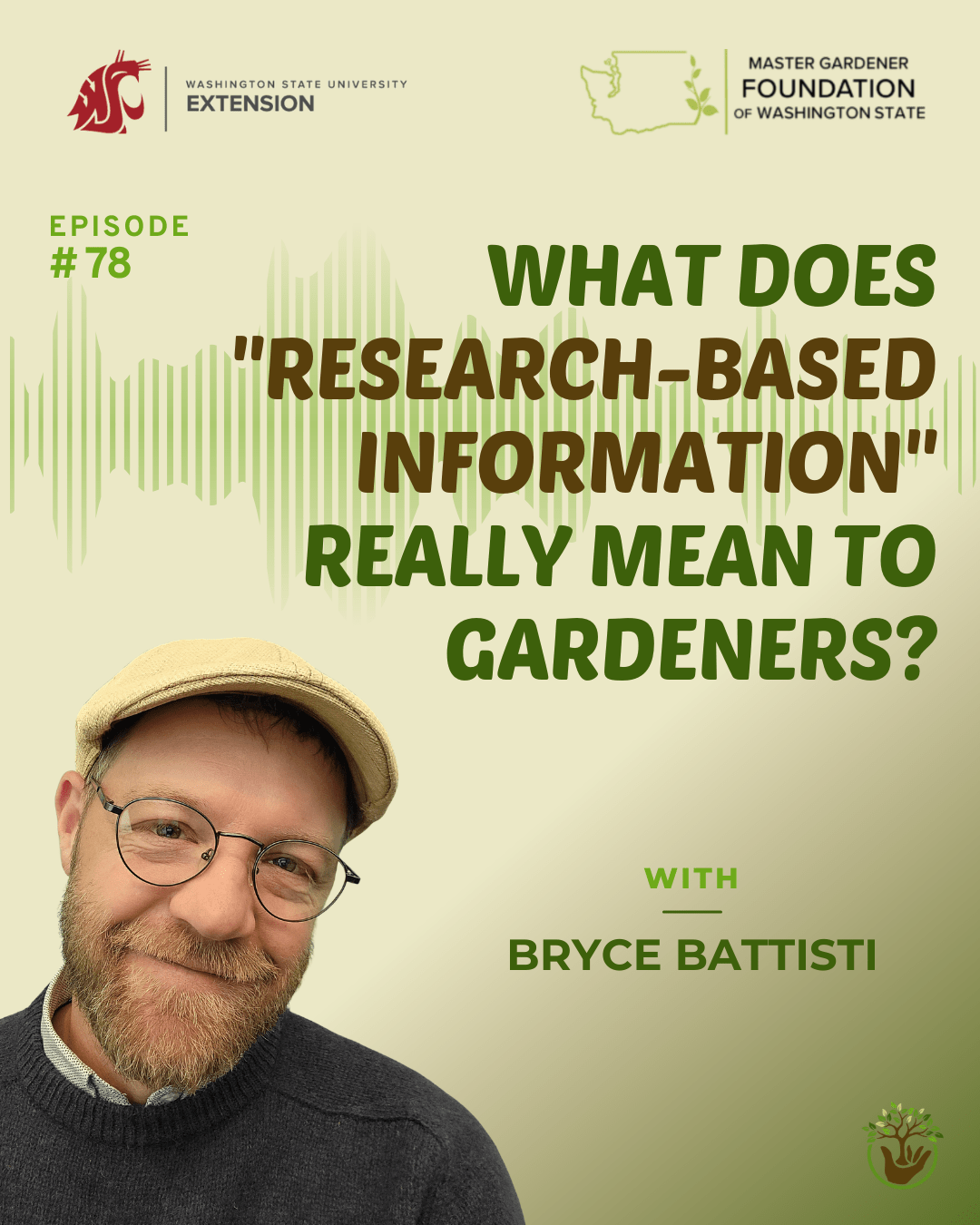
Dr. Bryce Battisti and Erin Hoover discuss what it means for gardening advice to be “research-based" and why it should matter to gardeners.

Affiliate Disclosure: As an Amazon Associate, the Master Gardener Foundation of Washington State earns from qualifying purchases. When you buy through our links, you’re helping The Evergreen Thumb Podcast grow—just like good fertilizer! Product recommendations are our own and do not represent the views of MGFWS or Washington State University. Thanks for supporting us!
In this episode of The Evergreen Thumb, Bryce Battisti joins Erin Hoover to explore what it means for gardening advice to be “research-based.” Drawing on his own experience, he explains that Master Gardener programs rely on peer-reviewed research from universities to provide relevant, unbiased guidance for local gardeners, rather than traditional or anecdotal wisdom. Bryce describes how even widely accepted practices can be debunked by new research, highlighting the importance of critical thinking and accessing local extension resources for reliable, climate-specific advice. The conversation also touches on the evolving nature of science, the persistence of gardening myths, and the need for patience and skepticism, as gardening results often take time to appear. He emphasizes that using research-backed information helps gardeners avoid wasted effort, save money, and prevent unintended harm.
Dr. Bryce Battisti holds a PhD in Sustainable Agriculture Education from the University of California, Davis. He taught biology at colleges and universities here and abroad, online and in-person, before pivoting toward instructional design in the last 10 years. Bryce is a backyard gardener who favors perennial food crops and loves to prune fruit trees. Hired by WSU Extension in 2023 to revamp the online portion of the Master Gardener program, he also helped found WA Green School and is the designer, coordinator, and host of its flagship Washington Gardener Certificate course.
Listen Now



Resources on Research-based Gardening
- Washington Green School
- Pacific Northwest Gardeners Handbook
- Wound Dressings: Results of Studies Over 13 Years. Alex L. Shigo and Walter C. Shortle. Arboriculture & Urban Forestry (AUF) December 1983, 9 (12) 317-329; DOI: Wound Dressings: Results of Studies Over 13 Years
- Effect of drainage layers on water retention of potting media in containers. Avery Rowe. Published: February 25, 2025. Effect of drainage layers on water retention of potting media in containers
- WSU Extension Publications
- Garden Truths: How to Identify Credible Gardening Advice Episode 25
- Nature’s Calendar: The Value of Phenology in the Garden Episode 37
- Inside the New WSU Green School with Jennifer Marquis Episode 49
Transcript
Erin Hoover (00:00)
Welcome to episode 78 of The Evergreen Thumb. My guest today is Dr. Bryce Battisti. Bryce holds a PhD in sustainable agriculture education from the University of California, Davis. He taught biology at colleges and universities here and abroad, online and in person, before pivoting toward instructional design over the last 10 years. Bryce is a backyard gardener who favors perennial food crops and loves to prune fruit trees.
Bryce was hired by WSU Extension in 2023 to revamp the online portion of the Master Gardener Training Program, he also helped found Washington Green School and is the designer, coordinator, and host of its flagship Washington Gardener certificate course.
Erin Hoover (00:40)
Bryce, thanks for joining me today. Welcome.
Bryce Battisti (00:43)
Thank you.
Erin Hoover (00:44)
So today we’re going to talk about what research-based means. And I wanted to start off by reading the Master Gardener mission because that’s kind of where this idea is based, or our conversation will be based. The Master Gardener mission is engaging university-trained volunteers to empower and sustain diverse communities with relevant, unbiased research-based horticulture and environmental stewardship education.
What Research-Based Means for Home Gardeners
Erin Hoover (01:08)
So I want to kind of unpack the research-based part of that today and talk about why that’s so important and why it should matter to home gardeners. So to start, let’s talk about what does research-based really mean.
Bryce Battisti (01:20)
Okay, yeah, this is an important question. So I joined the Master Gardeners a few years ago in Thurston County, and I probably did it mostly because I wanted, like, a garden club. This was during the pandemic. But the coordinator there was very clear about the fact that we are taking research that is produced by University Extension at Washington State University, the things that our scientists are going out and trying out in the field, and we are translating that into what could be useful for the gardeners in our area.
At the time it seemed like, wow, she’s going to such great lengths to explain, like, here’s what we don’t talk about and here’s what we do talk about. And if somebody asks this question, just say, that’s really interesting. You know, what I can offer you is what comes out of University Extension.
So that was really interesting to me, and I’ve been reflecting on it since we talked about it and then in preparing for this. And I wondered if I could tell a little bit of the story of my journey with this research-based question.
Erin Hoover (02:25)
Sure.
Bryce Battisti (02:27)
Okay, so I always loved biology. Like in school, that was just my favorite subject. Came easily to me; I enjoyed it, thought it was fascinating, loved reading about all the research. My understanding was that it’s not something somebody’s making up or just feeling like in English or just saying, know, this is nice or something, but this is research that’s been done and here’s what we came up with.
And it has changed over years. So that was really fascinating to me. I loved it. So when I went on to college, I got the opportunity to go to university. I decided to study ecology because I thought, I don’t know, that’s the most interesting to me, right? It wasn’t super thought out, but I also really loved ecology.
And we studied just all the things that you can imagine in ecology: the interactions between organisms and their environment, interactions between different landscapes; I found it really fascinating. And I found it really frustrating because the people that I was learning from and looking up to, because I wanted to be a professor someday, were doing these incredibly specific studies on, like a subpopulation of an endangered bird on a remote island and the predator effects.
That’s what they had spent 30 years on, right, and I just thought I cannot imagine doing that much research on something so specific just to find out what I don’t know, like I guess it’s going to inform ecology in the long run, right? It’s going to inform the bigger picture.
So anyway, I finished my degree by the end of it; as I said, I was kind of like, boy, this research thing is a drag. I know, like it’s too specific; I’d rather just kind of see what works, and I came across just accidentally. I was starting a garden, and I came across this book on permaculture in the local public library and read it, and I was amazed.
I was like, it was like everything came together for me in my mind, like all that stuff they taught in ecology; now in this book they’re saying here’s an application and this is for the specific benefit of humanity, not necessarily this bird on this offshore island. Fell in love with it, started reading about it, and thought, I hope I can study this further, like academically, because I wanted to be an academic. I went on to do my master’s degree, and when I was there, I went through their library, and they had a few things on permaculture, and one of them was this old video.
Literally, I had to go to the desk with my card that I found out of the card catalog, you know, and ask for this videotape, and she brought out this VHS, and I had to go into a little room and put it in the machine. And it was an episode of an Australian gardening show. I think it was called Global Gardener or something. The founder of Permaculture was being interviewed.
And there was this scene that stuck in my mind where, they’re sort of filming this, you know food forest area where there’s lots of different trees fruit trees and stuff and he sort of like comes out from between some trees with I don’t know a couple of peppers or something in his hand and sits down in a hammock and he says this is where the designer becomes the recliner and I was just like so taken by this idea like my gosh if we really do this like if we really apply ecology to growing food we can basically just relax while the food grows for us.
So I finished my master’s degree. I didn’t get to study permaculture for a whole lot of reasons. I had to do some other things. Went on to a PhD, and I was then working with actual agriculturalists, like professors in agriculture and experts in organic gardening.
And as I told them about my excitement, I’m really into permaculture. They just kind of nodded, and I started going to conferences and presenting posters and talking about it, getting together with other students, and had an experience where I had a, I guess it was a poster presentation, and some people came up and asked me some questions, and one of them was an agriculture professor.
Basically, she just said, I have a lot of students that are interested in this permaculture thing, and can you show me the research that supports it, that supports the claims, and once you can do that, you know, I’ll be on board is basically what she said.
I think I kind of shrugged it off at the time, you know, I was like, well, whatever, know, like this is really cool. This is this is important, and it’s all about ecology, but over the next few years, as I studied more, I couldn’t find the research. I found a lot of claims, a lot of advice, a lot of you know, sort of inspirational stories, and I still loved it, but I couldn’t find any research.
(07:06)
And so I thought, fine, what I’m going to do is I am going to grow my own garden. This is a long story, but so I decided, OK, she’s saying, show me the research. I could do something like that. I could have a garden that’s really amazing. So I started looking into how I could garden.
There’s this other original permaculture guy called David Holmgren. And I had met him at a conference in Brazil. And I was like, fine, I’m going to I’m going to follow what he did.
(07:32)
And he has this whole, it’s a little bit disused these days, but like a website where he describes, here’s what I did on my property. I bought a piece of property. He has pictures. He has descriptions of how much food he produced.
It’s pretty impressive. Then at some point I was watching another Australian gardening video where they were featuring him, right? And they show all the cool things that he had done over the past 30 years or something.
And then there’s this scene where He’s being interviewed in a vegetable garden. The interviewer says something like, so I noticed you’ve talked about edge effects, and you’ve talked about polyculture and really mixing things together. But I noticed behind you have just a row vegetable garden, like a typical garden. And he just kind of said something like, yeah, well, we do have a new intern here, and we’ve found that this is actually more productive if we just grow vegetables like this or something.
(08:26)
And for some reason, that was just it for me. I was like, right. Anybody can claim anything about gardening. Anybody can say anything they want about like what is great gardening. But it needs to be verified by research. If we’re going to teach it to other people or we’re going to say that it’s generally applicable or that it might work for someone else or that people should listen to it.
That was a big moment for me, just watching that video. And it probably didn’t mean anything like that to anybody else who watched that video. But because I had spent so much time thinking about this and wondering about it, it really struck me. And then I started to think about other gardening advice that I got from my dad maybe, or that I got from my mother-in-law who’s a big gardener, or that I heard on the radio, or that I saw in the newspaper, or that I saw online on YouTube. And I just had to think, man.
(09:16)
There’s a difference between scientific, like we’ve actually tested this in replicated field trials, and quasi-scientific, where we’re referencing science that has been done and saying, here’s a new thing you could do with it, without connecting the dots scientifically. So that’s my long story for that question.
Erin Hoover (09:35)
All right, so you talked about studies and field trials. How do you separate that from the traditional advice, like you mentioned, or the marketing, or the latest gimmick that’s on the market?
Bryce Battisti (09:50)
Mm-hmm. It’s not easy, actually.
And I hope Master Gardeners don’t get too mad at me for saying this.
Comparing and contrasting traditional knowledge about gardening with research back to gardening is a little bit more difficult than we make it out to be sometimes because we would love it if there was a specific research experiment that had been done on every single possible gardening question that we wanted answered so that we could just say, gosh, my broccoli are looking really stunted right now. What do I do about that?
And it’d be great if there was just like, great, well, somebody down the street from you at a research station this year is doing some research on broccoli, and because you’re in the exact same situation, you’ve had the same weather, you can exactly compare, but it’s not that easy.
Field trials are done. On topics that we have time for and that we have money for and that we have staffing for, and those results are published eventually. It takes a while. Sometimes it takes a couple of years because we believe in a system where if you do the research, you want to have your peers check it out and make sure that you haven’t missed any steps and that you have reported all the things that happened and that you’ve reported it in a way that others could replicate your experiment if they wanted to.
And that takes time. It takes money, and it takes effort, and it takes staff. And so, we don’t get to publish as much stuff as we would want to, I guess is what I’m saying.
(11:22)
Also, we don’t at all want to discount traditional gardening knowledge because that’s how gardening has come about, is people want to grow plants or have to grow plants or want to grow their own food or have to grow their own food. Whether it’s traditional practices or indigenous practices, those a lot of times can inform what research needs to be done, or that can be done.
Erin Hoover (11:45)
So, that makes me think of phenology. The old timey sayings about, know, plant corn when the oak leaves are the size of a squirrel’s ear or, you know, things like that. But the USA National Phenology Network has actually been studying those types of sayings and correlating them to when the soil temperature gets to be a certain point, or when the daytime temperature is a certain point, those things actually do correlate. And they’ve been able to test that against actual weather data and the science of it.
Bryce Battisti (12:15)
That’s a great example. Yeah. Yeah, we go off the observations that we make. And if somebody can go to the effort, like you’re saying, of keeping track of all of those, it can be really useful for other people around us.
So I just wanted to finish up that topic about like traditional knowledge by saying that we as master gardeners, we’re not trying to police people’s gardens or tell them not to do certain things. It’s just that if we are asked how to do a certain thing, the only thing that we can answer is by what research has shown.
Erin Hoover (12:48)
Last year, I think it was, I did an episode on gardening myths, and I’ve seen this come up over and over, you know, using Dawn dish soap as, you know, in a cocktail for a weed killer or something like that. And when you think about, you know, they use Dawn dish soap to clean oil off of sea mammals in an oil spill.
Bryce Battisti (13:01)
Mm-hmm.
Erin Hoover (13:11)
So what is that doing to our soil? We don’t know, you know, what the long-term effects of using something like that on our soil is, because it’s not been tested.
Bryce Battisti (13:15)
Mm-hmm.
Yeah, right. So, there’s so many things that just, when we hear them, and this happens to me all the time, I hear some gardening advice and it just sort of makes intuitive sense to me. In my mind, I think, that’s great. I have it on hand, so I’ll try it. I don’t have to go buy something special or read some directions or something. I’ll just mix it up, and I’ll just see what happens. But right, it could be just ineffective, or it could have some bad unintended consequences.
Garden Practices That Have Been Debunked
Erin Hoover (13:48)
Yeah. So, what are some examples of gardening practices that were once common and widely used that maybe have been debunked or they’ve been proven not to be effective?
Bryce Battisti (14:04)
A couple of examples for this, and one of them I might wait till later to mention because it’s even more complicated in my mind just from some research I’ve been doing this week. So the Master Gardener program started in the 1970s, and around that same time there was also a-I don’t know, he sort of became a celebrity- this guy named Jerry Baker who started calling himself America’s Master Gardener.
He was becoming really famous and popular around the same time. He published books, he was on radio shows, he was on TV. And basically, his whole thing was homemade tonics and homemade methods and sort of folk wisdom about how to do things; people believed it and followed it.
One of the like worst ones they say that he taught was to use chewing tobacco juice for insecticide, but it’s really highly potent and causes other problems and kills off all the insects sort of thing. Anyway, so he had all sorts of advice.
One of them was painting tree wounds like from pruning cuts with latex paint or tar or just different sorts of things that he recommended because the thinking at the time was while this tree has a cut, we need to bandage it just like if a person had a cut, we need to bandage that up or it’s going to keep bleeding, it’s going to leave this big scar, it’s going to be terrible. So, people did that for years. There were all sorts of products that you could buy. There was advice, probably even from University Extension, on how to, after you prune, to go ahead and paint up all those wounds.
(15:42)
I think I sent you a link to this study, but like a 13-year longitudinal study of these researchers dissecting hundreds of trees where the wound happened and if they had been painted over or not and comparing what happened. And it turned out that they didn’t prevent decay. And in fact, most of the time they actually encouraged decay by sealing in the tree.
It was a great example of how we can’t use common sense to think about how to treat trees based on how we treat our own wounds because they just heal in a completely different way. They work differently biologically. So, it just doesn’t apply. Anyway, I think that’s a really great example of something that everybody just knew. This is the way it is, and this is how you fix trees after they’re cut. And it turned out to be counterproductive.
Erin Hoover (16:25)
You can still buy those tars or paints to apply to tree wounds. I’ve seen them still in big box stores.
Bryce Battisti (16:34)
Great. Yeah, that’s an interesting point, right? Just because we feel like we’ve come full circle and figured this out, it doesn’t prevent people from selling those things or other people from teaching them. And so then it becomes a matter of trying to find out where you can get verified correct information.
Why Research-Based Information Matters
Erin Hoover (16:56)
Why does research-based information matter so much for the public or for home gardeners?
Bryce Battisti (17:03)
So Washington State University is a publicly supported institution. There’s taxpayer dollars going to support the research that’s happening at Washington State University. So, as residents of this state and those who have paid tax dollars, it seems like we’d want to get the most out of it and actually use the information and the research that’s produced.
Another one is that we can use, like your example with the dish soap and the painting trees with tar, or another sort of favorite example of mine because I’m actually a perpetrator of this, is planting apple trees and not spraying them for coddling moth and apple maggot.
In the university extension publications, they’ll say, just don’t even plant apple trees if you’re not going to take care of them like this, because it’s such a problem for commercial orchards that you’re spreading these pests. The effect of what we do in our own home gardens spreads and can affect the farms around us. So even though I don’t live off my apples because it’s just a nice treat in the fall, I could be damaging the crop of somebody who their entire living is off of apples. That would be an example.
(18:17)
I guess to come back to what we were saying before, so that we can have some idea what to believe about what would be the most effective method. And I know there’s a lot of pushback against science that regionally now might be stronger than it has been in a long time.
I guess all I would say is if you want your information to come from a source will tell you everything that they tried and exactly what worked and didn’t work, then come to Extension and come to the Master Gardeners because we’ll tell you what the research showed, what the research didn’t show, and you can evaluate from there rather than having to wonder if it was just somebody posting a video to try to get more likes and saying whatever they want in their video or selling a product to try to make more dollars or somebody that just doesn’t know anymore.
(19:11)
Anyway, I guess just in the end, I just wanted to acknowledge it’s like an uphill battle. My father-in-law emailed me the other day to ask about how we could make his lawn smoother. And so of course, being in the job that I am, like I run the Green School course and I’m a Master Gardener, I thought, okay, well, I’ll give him the Master Gardener stuff first. I’ll give him the chapter that we have in the Pacific Northwest Gardener’s Handbook on lawns.
I’ll refer him to his local master gardeners because it’s people that live right there in his county. They can answer these questions, and then I thought, well, I’ll also mention his other son-in-law who maintains this very pristine lawn, right? Because I don’t, I don’t really care about my lawn. It’s just rough and bumpy, and I know what, when I have to, and his response to me was something like, right, that’s a good point. I will reach out to my son-in-law about lawn advice.
And I just thought, did he even look at anything I sent him? Does anybody? Is it too hard for us to do that? I find myself, I’ll go out in the yard and I’ll notice something that’s off and I’ll think, okay, well I could go back inside and I could sit down and try to look this up and I could get out a book that I have that I know is scientifically based and there’s all these things I could do, right?
I know the sources, or I could just ask my chatbot while I’m standing here, and I’ll tell it that I want it to be based on university resources and it’ll probably be good enough. Anyway, I wonder if that’s what most people are doing.
Erin Hoover (20:43)
Yeah. Well, and, you know, things like Facebook groups, everybody has an opinion, everybody has an idea when somebody poses a question, and they’ll get 10 different answers. You know, how do you know which one to follow?
Bryce Battisti (20:56)
Mm-mm. The person you trust the most, maybe.
Erin Hoover (21:00)
Pick one out of a hat or do a little research on each of the options and see which one seems the most likely or that has some research behind it?
Bryce Battisti (21:09)
Well, and that reminds me of another thing, Erin, is that sometimes I think, OK, well, what’s the risk? What’s the harm? Like, I’ll just try this thing that somebody suggested.
But then after enough seasons, I’ve realized, I’m going to waste a lot of time and a lot of effort trying things that might not work. You know, like if I’m going to try this thing and it’s just something somebody told me and I’ll just see what happens, that might be six months of effort worth of like doing this certain practice to see if it worked in the end so that next year I can think, okay, well, that one didn’t work.
Do I just keep doing that? Do I just look for the next Facebook post that says something different and try that? Trial and error on our own is a pretty hard way to go. And it ends up costing time and money sometimes.
Erin Hoover (21:57)
Yeah. Yeah, definitely. You kind of mentioned this already, but you know, science changes, you know, and that’s the point of science: to continue to learn and to continue to study, you know, different aspects of the world we live in and learn more about it. So as we learn more, you know, what we’ve always thought in the past isn’t always going to be correct. So how do we manage that? When sometimes, as we get more knowledge, other recommendations may change.
Bryce Battisti (22:36)
So the first is what you said: to realize that that is a strength of science rather than a weakness.
Science at its best is open to new discoveries, and we keep researching, and if we find out that something we taught before isn’t actually true, then we would let everybody know. I would say probably the hard part is letting everybody know because, so I’ll use the example of my mother-in-law now. She’s not going to, I mean she’s been gardening for, she’s 80 this month, this weekend actually, you know, she’s been gardening pretty seriously for 50 years, let’s say.
And probably before that, she was learning some gardening. She’s not going to go find out what the latest research on this topic. One of the things, actually, that she does is when she gives me plants, because she’s very generous and she’ll give me plants, she always puts them in a pot and puts rocks in the bottom, like gravel. And I’ve asked her before, why do you do this? And she said, it’s for drainage.
Bryce Battisti (23:43)
Started working with the Master Gardener program. I read about that. And actually, in our house plants chapter, we have a whole sidebar that’s about like, don’t do that.
Like, don’t try to add some sort of coarse material before you put in the potting mix and put in the plant because it’s actually not going to help drainage. It’s going to create what’s called a perched water table where, like counter-intuitively, like you’d think the water would just sort of like drop out of the potting soil through the rocks, but instead it sort of like suctions up and stays in the potting soil, and then you have water collecting closer to the roots of the plants that can cause damage.
And I have thought about how I can broach this topic with her, because again, she’s the one giving me the plants. I feel like I wouldn’t be very grateful if I questioned the way that she was doing it.
But I thought a lot about it and actually, in preparing for this, I thought okay, I’m gonna look this up more and see what I can find about it. So, I read, okay, let’s say skimmed the original papers by this guy named Arts Boomer in the 1970s and 80s and read about it. It turns out his experiment was with sponges was with cellulose sponges, and so basically, he kind of like got some sponges wet and set them on some gravel and could show that actually the water doesn’t all drain out of the sponge. It sort of collects on the bottom edge of the sponge against the gravel.
And then he started using this as his demonstration in extension and teaching Master Gardeners and stuff to say, if you have a potted plant in some potting soil and you put gravel underneath, the water is going to stay in the soil.
(25:28)
So, while I was researching this, I came across an article that was written by an, don’t know what you call it, like an unaffiliated scholar. I don’t have it up right now, but… anyway, it’s online, it’s in a scientific journal online, and it’s been peer-reviewed, it says, where he just basically called the whole thing into question and did experiments with actual pots of potting soil with different mixtures of fine sand, coarse sand, sort finer gravel, coarser gravel and his finding is that it’s just not true at all. That actually it does not impede drainage and in some places, in some situations, improves drainage.
So, if that is borne out by other research, then again, we would have to change, right? Like we’d have to say, okay, well, actually more current research is showing this, and now we’d actually like you to do it this way. So again, I think that’s a feature. I think it’s a strength of science. The difficult part is to get that message out.
Erin Hoover (26:25)
The research that WSU does- why is it more relevant to say, gardeners in Washington than, say, you know, research is done in California or is done on the East Coast?
Bryce Battisti (26:41)
Mm-hmm.
Right, and even asking that question gets us halfway there, right? Like, even if we’re thinking about like, “does this apply to my own situation?” is fantastic. I think this is another Facebook example. My wife the other day was saying something about, like, I saw this thing on Facebook about growing tomatoes, something something, and I just kind of had to be like, let me stop you right there. If that sounds like it’s in a tropical climate where tomatoes actually grow year-round. We can’t do that here.
It just it doesn’t work unless you have them inside in a heated greenhouse. And she’s like, well, it didn’t say on the post where this was from or who it was for. It just said, here’s a great way to grow your tomatoes now. Anyway, there are a lot of examples like that.
So if we stopped to question, first of all, was any research done on this? And if it was, where was that research done? Under what conditions? And how might that apply to my particular microclimate? Because even across Washington state, we have a lot of different climates.
Bryce Battisti (27:37)
I have an uncle that lives right out on the Pacific Ocean. On the coast there very different climate from me; that’s just two hours inland. You know, we have like the High Cascades area where people live where it’s just completely different from Eastern Washington or Western Washington; it’s the applicability. I guess like is this going to work for me? Is hard to know in most posts, but if you do consult Master Gardeners, they’ll be able to tell you where this information applies to.
Erin Hoover (27:54)
Mm-hmm.
Bryce Battisti (28:03)
I actually, just before we got on this interview, I came across in an interview that there’s a master’s degree student at the Puyallup Research and Extension Center going up for the final defense of her research. And her research, she’s working with one of our composting experts, Doug Collins, and working on using seaweed biomass as an amendment for soil.
Erin Hoover (28:29)
Mm-hmm.
Bryce Battisti (28:32)
The findings look positive, just so that you know. But the great part about it, and all I did is read the abstract, is that this research is going to say where they did the research, under what conditions, under what times of year, what different variations they used, like this much biomass, this much biomass, after this many months, after this many months, they actually had the research to do soil tests each time and find out how it affected the soil in lots of different ways.
So that could be a really useful piece of research, and we know the details behind it, and like we were talking about before, if it ever changed, we would get that updated as well and know where and when and how it’s applicable to us in our gardens.
Erin Hoover (29:15)
Mm hmm. Right. As Master Gardeners, we’re encouraged to check WSU research first, not just because we’re part of WSU, but because it’s going to be the most applicable to the climate we live in. And then, you know, if we can’t find the research that we’re looking for, look at surrounding land grant universities. So Oregon State or University of Idaho, or even University of British Columbia.
Bryce Battisti (29:30)
Mm-hmm.
Erin Hoover (29:42)
Because they’ve got very similar enough climates that a lot of the research they do would be applicable.
Bryce Battisti (29:51)
Right, and then it gets us onto the topic of how do you find that information? And it would be really great if we had like, entire marketing arms of our research centers or something like that that were just like flooding the market with this excellent research-backed information. It just isn’t true. And often what happens actually is that other groups will sort of pick up research that’s been done and teach it. So then it becomes harder, right? Like, where is that? Say it’s a gardening club or Seattle Tilth or something like that. Like, where are they getting their information? Hopefully they’re citing it.
But yeah, you’d look for the .edu, or you’d look for the university affiliation. You’d look for the references that research uses to see if they’re basing their theoretical standpoint on something believable.
(30:47)
I guess another thing that I would say is that often, perhaps frustratingly, research-backed horticulture and environmental science information is not very sensational. It’s quite, I don’t know what the word is, like reserved and conditional and careful in its language.
Under these conditions, in this location, we conducted this research, and we really encourage other people to further this research. You know, this is all we had time for, and here’s what we’re pretty sure we can say with this much statistical accuracy at this point. And that’s about as far as we can take it. So it’s not very inspiring, but on the other hand, if you’re listening to things that say, try this one trick, and it will solve all your garden problems.
Probably that’s not backed up by research because that’s just not how the world works.
Erin Hoover (31:48)
Yeah. Yeah, they gotta keep it keep an eye out for that sensationalist. Because the horticulture research is not the kind of research that makes headlines. Often.
Bryce Battisti (31:55)
Mm-hmm. Wow, right, yeah, that’s true, usually.
How to Verify Your Information is Research-Based
Erin Hoover (32:03)
So what are some other red flags or simple ways to kind of verify where your information is coming from that it’s going to be research-based or scientific?
Bryce Battisti (32:14)
Okay, so hopefully it’s from University Extension. There’s also research that comes out of universities that don’t have Extension, like the University of Washington. They have some great departments that are doing research on horticulture.
There are like plant societies focused around certain crops or certain ornamental flowers and things where they are basing their findings or recommendations on research that they have explored from other areas and then field-tested somewhat, you know, in the local area. And they might have useful things to say about that.
Red Flags that Indicate Information May Not be Research-Based
Some of it’s like the red flags for what probably isn’t research-based, or to make things even more complicated, ones that might be based on research but for a very particular reason, and a lot of times that’s what happens with products or companies.
Like things that are actually dangerous, that are like obviously dangerous, like chemicals, pesticides, and things like that, often they have to meet legal requirements, so they have to do some research. There has to be some research. But of course, their absolute motivation for that is to get their product approved legally so they can sell it. So you’d hope that there are checks and balances enough, but things that aren’t regulated like that, there’s of course a very high incentive for the maker of the product to claim that it works because that’s how they sell it.
So, if they’re saying thousands of gardeners around the world have tried this, and it works great. If they are backing that up with university research, that’d be great. Often not, right? Often, it’s more like testimonials. And testimonials can be biased, testimonials can be bought, and testimonials can be really early.
Erin Hoover (33:45)
Right.
Bryce Battisti (34:11)
I often have the experience where I’ll read the reviews of something, and somebody will read this glowing review, and they’ll say, after one week it’s just amazing. And I think, well, after one week, how could you know if it’s amazing? That’s not enough time. Maybe after three years or something, maybe you could get back and leave a review and let me know if it works? Because that’s not enough time.
Where to Find Research-Based Resources
Erin Hoover (34:33)
All right. So, I guess to kind of wrap it up, where are some of the best places to go for resources that are research-based? We talked about extension, but some of the more specific ones.
Bryce Battisti (34:50)
Okay, so all of the Master Gardener programs in Washington State maintain websites. So this is by county. And those websites link to all of the university resources for different gardening topics. They all, as far as I know, have a link where you can ask for more information. And there are volunteers who’ve been trained on finding the best research-based horticultural and environmental science information who will jump at the chance to look up your specific question for you and direct you to the specific resources you need. Kind of like a librarian for gardening. So that’s a really good one.
Washington Green School
I run an online course that is affiliated with the Master Gardeners. And in fact, all new Master Gardeners take this course. And that’s called the Washington Gardener Certificate. It’s through Washington Green School. That’s a great course if you have the time and resources to take that; please do. That’s a really comprehensive overview of all the gardening advice that we have to offer for the whole state.
Part of that course is something called the Pacific Northwest Gardeners Handbook and I’m sure you’ll link to it, but that’s freely available online and anybody can look through those chapters and find the information that they need and hopefully notice if you do go to that resource that as you read it that there are references at the bottom of each chapter and those references are to research that’s been done in the field. That’s what it’s based on; it’s not just written by experts, but also referencing the actual research I kind of mentioned.
Bryce Battisti (36:36)
But there are a lot of other Washington State University publications, and you already alluded to the fact that we can broaden that scope some to the University of British Columbia publications, Oregon State University publications, as long as they match your particular climate and soil type. Should be very applicable. And the ones that we use the most, I guess, are like HortSense and PestSense.
Those are two websites that are made specifically for this purpose. Like, if you have a specific question about a plant or a pest that you might have, you can look there and find direct advice. Instead of having to read a whole research paper on voles, voles are the bane of my existence this year, there’s just advice on what to do and then some links to further reading.
Erin Hoover (37:24)
Yeah, I like the way HortSense is laid out now. They did a big overhaul a couple years ago of HortSense, and it’s much more user-friendly. When you pick the plant that you’re looking to find, what your problem might be, they’ve got pictures of some of the different diseases or insects that are common to that plant, and then below that is all integrated pest management recommendations for controlling it. So it’s that’s a really good resource that I use myself from time to time.
Final Thoughts About Research-Based Resources in the Garden
Bryce Battisti (37:54)
So often at the end of your podcast you say, is there anything else you want to add? That was just making me think of an example and bring it back to a conversation that we had earlier about plant guilds that has always sort of made me wonder.
So a lot of the things that we try as gardeners have at least a one-season timeline to them. Like we kind of can’t know if something we did worked for like a whole season.
Erin Hoover (37:56)
Mm-hmm.
Bryce Battisti (38:22)
But sometimes it’s even longer than that. Like with perennial things, like fruit trees or something, or this idea of guilds is to, you explain it way better than me, but to plant like a fruit tree and then have some sort of ground cover under it that might also be productive and some sort of vining plant that might use the support of the tree and some sort of bushy things around that. So that they are, that the plants, in theory, are like helping each other and providing a great environment for each other so that they’re synergistic, so they’re all more productive than they would have been.
But that takes a long time to establish. So, say you took ten years, and you establish something like that, and it worked; some you’d have a hard time knowing is this more productive than if I had planted them each individually, and should I have ten years ago started by planting them each individually so that I can compare and then. If I was going to do that, shouldn’t I have replicated trials so that I can know that it wasn’t just this one spot that there was, like, bad soil or something like that, or there was, like, a really weird spring that killed off, you know, a lot of the buds.
And then I just wouldn’t know. Anyway, my point is, it’s over such a big timeline that it kind of matters what we put our faith in as gardeners, because we can’t; it’s going to be really hard to prove it.
Erin Hoover (39:39)
Mm-hmm.
Bryce Battisti (39:44)
So I usually fall back on science because I feel like, well, at least somebody tried it over multiple years with multiple conditions and multiple treatments, and they can tell me that, yes, under these conditions it worked in this way. And I understand a lot of people don’t want to put their faith in science. That doesn’t make sense for them, but they have their real doubts for different reasons, but for me it’s reassuring to know that I really can’t test this on my own, and so I’m gonna go with the science.
Erin Hoover (40:15)
Bryce, thanks for being here today. This was a great chat.
Bryce Battisti (40:19)
All right, thanks, Erin. It was great being here.