
Bees, Flies, and The Hidden World of Insect Collections
Join Dr. Joel Gardner to learn how WSU’s M.T. James Entomological Collection supports research and pollinator conservation, especially for sweat bees.


Affiliate Disclosure: As an Amazon Associate, the Master Gardener Foundation of Washington State earns from qualifying purchases. When you buy through our links, you’re helping The Evergreen Thumb Podcast grow—just like good fertilizer! Product recommendations are our own and do not represent the views of MGFWS or Washington State University. Thanks for supporting us!
In this episode of The Evergreen Thumb Dr. Joel Gardner, manager of WSU’s M.T. James Entomological Collection, shares the history and significance of the university’s insect museum, which began as a resource for identifying crop pests and now houses around three million specimens—including invaluable type specimens essential for taxonomic research. He explains the careful preservation and housing systems, the collection’s global scope, and its critical role in both scientific discovery and tracking biodiversity over time. Gardner, a leading expert on sweat bees, describes their unique social behaviors and ecological importance, encourages gardeners to plant diverse flowers to support these tiny pollinators, and emphasizes the museum’s value as a scientific reference and a living record of ecological change.
Joel is one of only two experts on North American Dialictus sweat bees. He obtained his PhD from the University of Manitoba advised by Dr. Jason Gibbs, the other expert, in 2023. He has described 33 new species over four published works and helped coauthor many other papers. He currently works full-time managing the WSU insect collection under the direction of Dr. Elizabeth Murray, where he is relied on to identify the thousands of bees collected by the lab as well as the Washington Bee Atlas, which recently recognized the collection as a critical partner. He lives in Pullman.
Listen Now about Insect Collections



Resources
- WSU Arthropod Collection Database
- Washington Bee Atlas
- Pollinator Habitat – The Bee Conservancy
- Bumble Bee Watch photographs and ID bumblebees, verified by an expert.
- Bumble Bees of North America: An Identification Guide (Princeton Field Guides) Described by Joel as a user friendly guide to identifying bumble bee species.
- Common Bees of Western North America (Princeton Field Guides)
- Oregon State University Bee Advocate Program
- Bees of the Pacific Northwest : key to genera (Hymenoptera : Anthophila)
- Bees of the Pacific Northwest : key to bumble bee species for males (Hymenoptera : Apidae : Bombus)
- Bees of the Pacific Northwest : key to bumble bee species for females (Hymenoptera : Apidae : Bombus)
- Other Podcast Episodes on Pollinators: Cultivating Resilient and Thriving Gardens
- Website: The M.T. James Entomological Collection
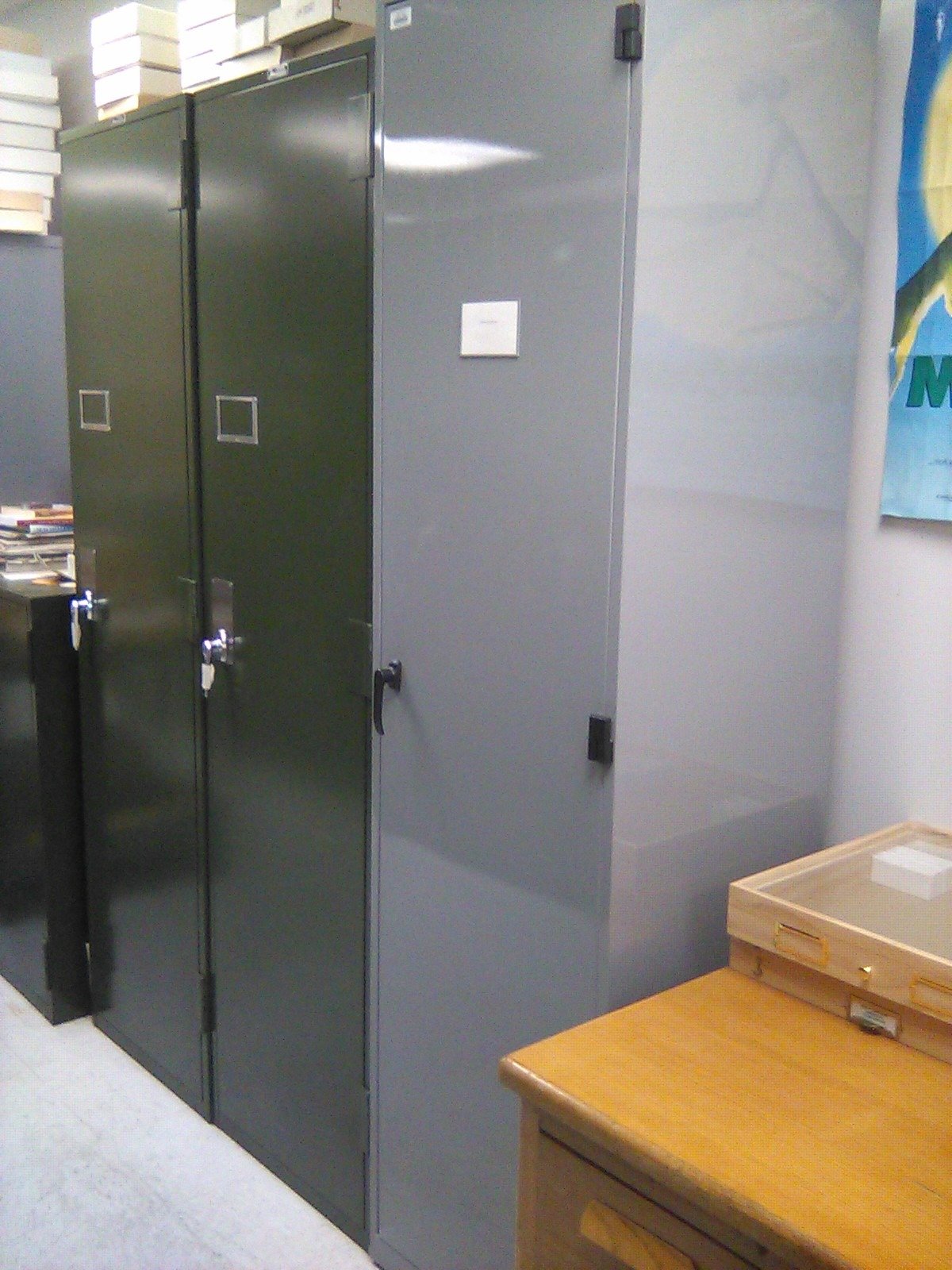
The gray cabinet contains the primary types. You can also see a drawer in the corner that would go inside one of those cabinets.
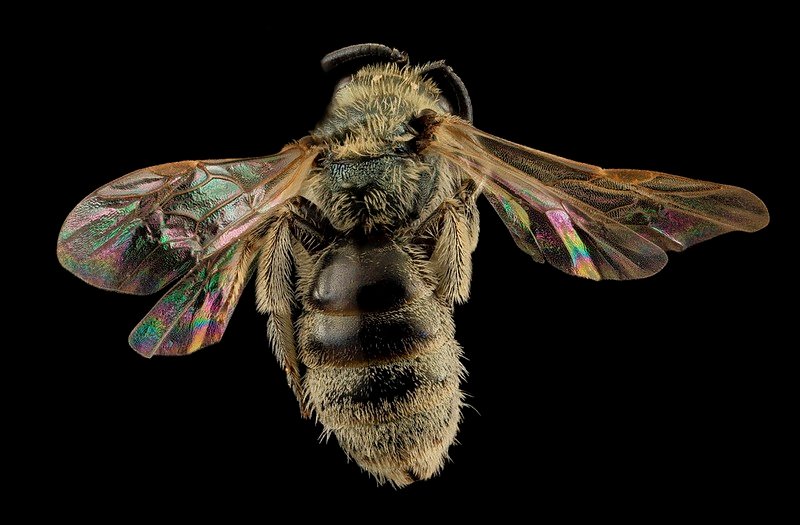
“Lasioglossum perpunctatum, F, Back, MI, Alger County_2014-03-21-15.05.33 ZS PMax” by USGS Bee Lab, Public Domain Mark Photograph by Brooke Alexander
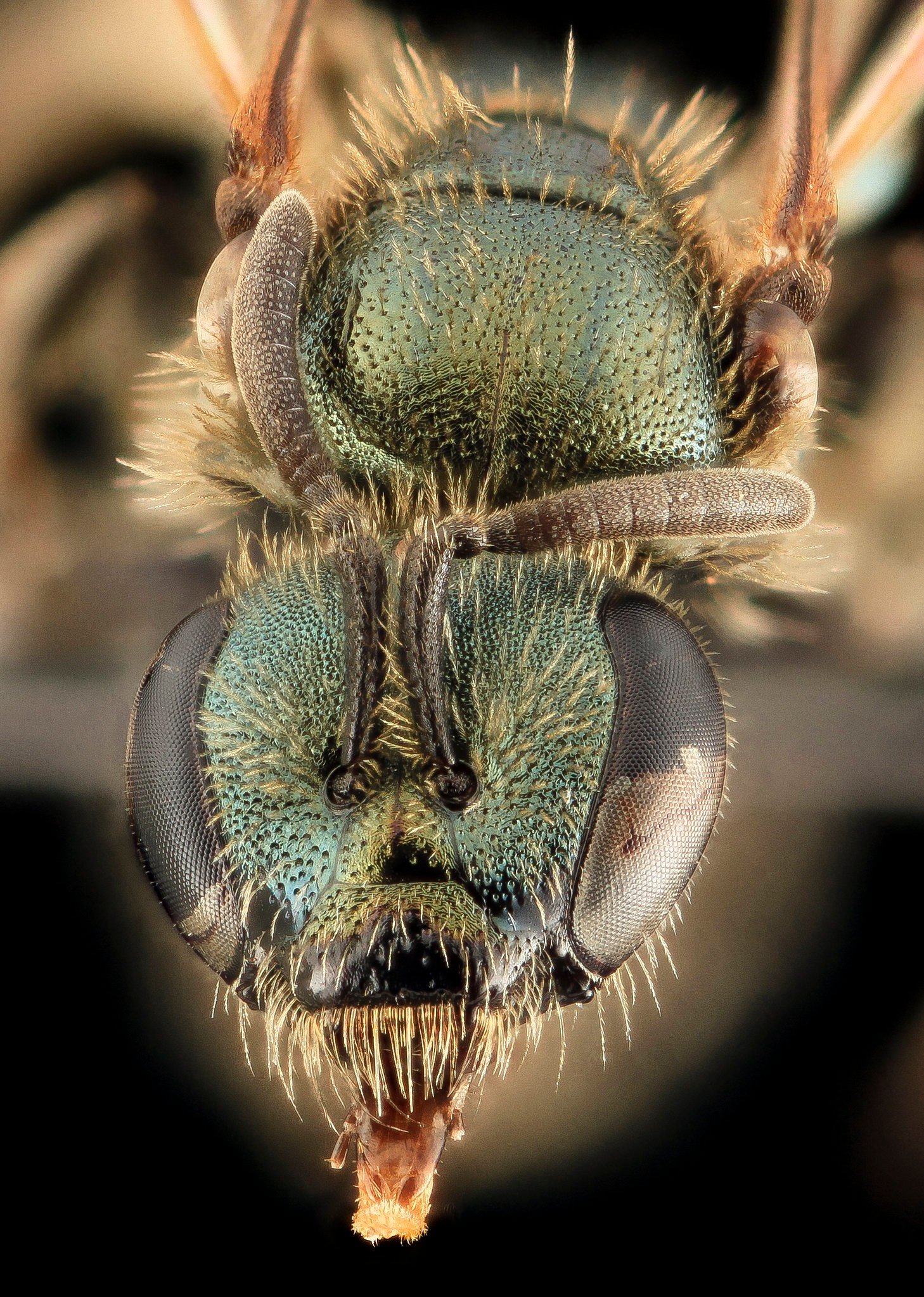
“Lasioglossum knereri, F, Face, WA, San Juan County_2014-05-09-19.03.28 ZS PMax” by USGS Bee Lab, Public Domain Mark
Transcript
Erin Hoover (00:00)
Welcome to episode 72 of The Evergreen Thumb. My guest today is Dr. Joel Gardner. He is the collection manager of WSU’s M.T. James Entomological Collection and is one of only two experts on North American Dialictus sweat bees.
He’s here today to tell us all about the museum collection and a little bit about sweat bees as well. So Joel, welcome. Thanks for joining me.
Joel Gardner (00:26)
Hi, I’m glad to be here.
The M.T. James Entomological Collection
Erin Hoover (00:29)
Can you tell us a little bit about the M.T. James Entomological Collection and your role with the collection?
Joel Gardner (00:36)
Sure, so the M.T. James entomological collection is as old as Washington State University. It was established about the same time that the university was established as a land-grant institution, and originally, the mission of the insect collection was pretty much crop pest diagnostics. There’s a lot of agriculture in the Palouse Prairie.
So we had a collection of insects so that the farmers could come in and see what was in their crops, and what was eating it, and what they had to be worried about, and things like that.
That’s kind of like the original mission, and we actually still have some of those original specimens in the museum. So we have well over like 130-year-old specimens in here.
As long as you take care of them, you can preserve insect specimens basically indefinitely. They’re very easy to take care of because they’re all dried out. They have a hard exoskeleton, so that even if all the soft guts, even if those dry out and shrivel, the exoskeleton remains intact, which is what you’re looking at when you’re doing science.
So that’s kind of the cool thing about preservation.
Of course, the museum didn’t stay as simply an agricultural pest diagnostic service. We still do some of that. We still do maintain a lot of specimens for the purpose of identification when the public contacts us wanting to know what something is. But the scope has very much grown over the years.
So we have people working in here, and they go out collecting insects, maybe for their own projects or even just for fun, and they bring those specimens back, and they deposit them here. So the collection has been steadily growing over its 130-year history, and of course, as you’re collecting insects, you’re eventually going to run into things that you don’t know what they are. And when you collect something, you can’t figure out what it is. Then you have to do some taxonomic research.
So that is kind of like another big component of the purpose of the collection and the research we do. So originally, of course, it wasn’t called the M.T. James entomological collection. M.T. James, Maurice T. James, was a dipterist and a medical entomologist who worked at WSU. And he started, it was sometime in the 40s, I think. So, it was well into the history of the collection. But he did so much research, and he contributed so many specimens that the museum was eventually named after him after he retired.
Specimen Organization
Erin Hoover (03:40)
So, how are the specimens housed in the collection?
Joel Gardner (03:46)
There are kind of like three layers of housing. So, the first layer is that they’re organized into little like cardstock trays with foam bottoms. So you put the pins in the specimen into the foam, and that holds them in place. And then they’re in trays that you can move around so you can, like, pick up these trays of specimens and shift them around in the collection without having to, like, pick up and move every single pin individually.
The second level is drawers. So all these trays with the foam bottoms are organized into wooden drawers with glass tops so that you can kind of like look in there and see what’s in the drawer without opening it. These are special entomological collection drawers, so they’re made with very tight seals around the edge. So, each lid and each bottom is unique. They are ideally carved from one piece they fit perfectly snugly together. And that’s to prevent pests from getting in.
Then the third layer is that all these drawers are stacked up into metal cabinets. And the cabinets are what you see when you walk into the museum. So they’re big, tall, metal-like lockers full of these entomological drawers.
The Significance of Type Specimens in Taxonomy
Erin Hoover (05:06)
How has the scientific value of the collection changed, and what are some of the most valuable specimens in the collection?
Joel Gardner (05:13)
So the most valuable specimens in the collection are undoubtedly the type collection. So we have one special cabinet in the room that’s full of primary types. And the primary types are a result of taxonomic research. So when you do taxonomic research, and let’s say you have something and you don’t know what it is, and you figure out that it’s new to science. It’s a species that doesn’t have a name yet.
So what you have to do then is you have to describe the species, put a name on it, and publish it. And when you do that, all of the specimens of that species that you have, that you’ve looked at in that publication, become types. So all of them are at least what’s called paratypes.
And then among all of the type material, the author of the species picks one and says this one is the holotype. And the holotype is from then on the primary reference or kind of the definition, if you will, of what that species is. So if anyone needs to know, like, what this species is, what it looks like, you go look at the holotype.
And that’s like the definitive answer of what it’s supposed to look like. The paratypes are all the other specimens that were examined by the original author. And those should also be reliable reference material if you need to determine what that species is. However, there are cases where someone describes a species, and then it turns out later that they actually had a mixed series of paratypes, so there’s more than one species hidden in there.
So that’s kind of like the reasoning behind why you pick one to be the holotype, because then that fixes the name to that species. If you figure out that these paratypes are more than one species, let’s say that the name of the species was like Melisodes communis, and then you say, okay, so this is two species: which one should be called the communis and which one needs a new name? So that the holotype helps you answer those questions.
Like I said, we have a big, a special cabinet full of these primary types, these holotypes. Those are the most valuable specimens in the collection because they are irreplaceable. If they’re lost, there’s not a primary reference anymore for what that species is.
If anyone wants to do taxonomic work on it again, if you’re lucky, you might be able to find a paratype. And then you could say, OK, I’m going to make this paratype. I’m going to designate it as like a new type specimen to replace the old lost holotype. And if you’re not lucky, all the paratypes will be gone too, or you won’t be able to find any. And then you have to designate, like, a completely new type.
If you have material that you think is reliable for that species, or else you just have to say that this is a nomen dubium, which is a Latin phrase meaning uncertain species or uncertain name. And that just kind of like takes that species like out of the taxonomic literature. So it’s like, we don’t know what this is, and we can never figure it out again. So it’s very important to keep these type specimens safe so that that doesn’t happen.
Yeah, a lot of ours are flies from Maurice T. James. That was a big component of his research. He named a lot of fly species. But we’ve got an assortment of specimens from various authors.
Insect Collection Size and Scope
Erin Hoover (09:19)
So how many specimens are housed in the collection in total?
Joel Gardner (09:20)
Well, we don’t know for sure because there’s never been a very detailed specimen-by-specimen inventory. I have an estimate. This is based on counting how many drawers of specimens we have in the collection and then getting, like, an average value of, like, okay, about how many specimens are in a drawer. And the estimate that I came up with was about three million.
And that actually agrees with Rich Zach, who also works in the museum. He’s the curator before me. And he came up with a similar estimate. I don’t know what methods he used, but he came up with about the same answer that I did. It was about three million.
Unique Storage Systems in Entomology Collections
Erin Hoover (10:13)
I remember reading somewhere that the storage system, the drawers, something unique about them is that the Smithsonian is the only other one that uses that type of drawer. Is that correct?
Joel Gardner (10:25)
Oh yeah, so it’s not totally unique. It is unusual for the western United States though. So these special entomological collection drawers that we use with the glass tops and the tight-fitting lids. There are a couple of different standards for which dimensions are used. So it’s kind of like three big ones.
There’s the USNM; that’s what we use, and the Smithsonian also uses that. But it’s not just the Smithsonian; there are several other collections, especially in the eastern US, that also use these drawer dimensions.
And then there’s Cornell, which originated out of Cornell University. Those are about the same size. If you just look at them with the naked eye, they look the same. But if you try to put a Cornell drawer in a USNM cabinet, it’s not going to fit because they’re a little bit too wide. So you need different cabinets and everything depending on which drawer dimensions you’re using. And a lot of the collections out west, like around in our area, use Cornell.
So when we get donations coming in, a lot of times they’re in Cornell drawers, so it just makes it harder because then we okay we have to switch everything out into these USNM drawers so they’ll fit in our collection. So if we could go back in time and change what we decided to use originally, we’d probably say, okay, we should use Cornell. Because it’s just kind of a headache now, but now we’re kind of committed. We have almost everything in USNM drawers, and it’s kind of too late to go back.
Erin Hoover (12:01)
I also remember the museum is open for tours. Is that correct?
Joel Gardner (12:07)
Yep. So it’s not the kind of museum where you can just kind of like walk in and browse exhibits unguided. It is primarily a research museum, but what you can do is email one of the staff or there’s a general museum email if you look up the M.T. James collection and you find our website on the WSU website.
There’s some contacts there and you can email one of us and you can arrange sort of a guided tour. Especially if you have a large group, this is what we’d like visitors to do. If you’re just like one person or like maybe like a couple people, you can walk in and take like a quick look and it’s not too big of a deal. But we do want groups to schedule tours in advance and then someone will meet you, and kind of like go over the collection, take out some things from the research collection to show off some of our bigger, flashier, more attractive insects.
And depending on what you’re interested in or if you have any particular topics in entomology, like if you’re a class and you’re doing a unit on entomology and you’re studying something particular, we can kind of tailor the displays that get taken out for that.
Erin Hoover (13:31)
Nice. So how many specimens would you say are added on an annual basis?
Joel Gardner (13:39)
That’s really hard to say because it’s different every year. It’s probably a few thousand.
And that can vary a lot depending on if anyone donates specimens to us. So occasionally we get large donations coming in. Then we get, like, maybe like tens of thousands of specimens all at once that need to be processed.
We are also collaborating with the Washington Bee Atlas. The Bee Atlas is sort of a volunteer Citizens Science Initiative trying to document all the bee diversity in the state of Washington, and all the bees that they’re collecting are nominally going to be deposited here in this collection. They’re not physically here, but they technically belong to us. So if you count all those, it would definitely be at least 10,000 specimens getting added per year. Because the Bee Atlas is highly productive, and they have been collecting a lot.
Erin Hoover (14:38)
I have actually talked to a couple of guests about the Bee Atlas. I didn’t realize that they were recognizing so many new species.
Joel Gardner (14:44)
Yeah, yeah, the Bee Atlas has been making some amazing discoveries.
So yeah, it’s great to be responsible for housing those specimens and making sure that they stay available for future study because there’s a lot of data there. There’s a lot to be done with that Bee Atlas material.
Sweat Bees and Their Diversity
Erin Hoover (15:06)
That’s great. So, about bees, I know you specialize in sweat bees. So can you tell us a little about what sweat bees are and what’s special about this group of bees?
Joel Gardner (15:19)
So, sweat bees are, so they’re part of the short-tongued bees, which is a lineage of bees. So the bees are kind of divided into short-tongued and long-tongued bees. The long-tongued bees include most of the ones that most people are familiar with, like your honeybees and your bumblebees. Maybe your leafcutter bees and your mason bees too are long-tongued bees. Those are a little bit more familiar to some people, too.
The sweat bees are included like with the mining bees and the cellophane bees, and the yellow-faced bees. And they’re like a pretty significant portion of the overall bee abundance and diversity. So the genus that I work on specifically, Lasioglossum, diversity-wise, it’s actually the biggest genus of bees.
It has the most species in it of any bee genus. And with such a big genus, what typically is done is it’s divided into what’s called a subgenus. So there are multiple subgenera-that’s the plural of subgenus-within Lasioglossum, and one of them, the one that I’m particularly interested in, is Dialictus. That’s the biggest subgenus. So I work on the biggest subgenus of the biggest genus of sweat bees.
And the Dialictus are very small bees. They’re kind of a dull metallic bluish green, at least on the head and the thorax. Usually, the abdomen is kind of black or brown or sometimes red, or it can also be metallic. And they’re interesting because they have kind of flexible social behavior.
So they’re mostly primitively social bees. Everyone knows like the honeybees and bumblebees, they’re highly social, especially the honeybees. So they have like the queen, and they have, like, thousands of workers in the hive. And they have all these advanced behaviors, like they do like the dancing to communicate resources, they build the honeycomb, they make honey, the colony persists over multiple years, they have the reproductive division of labor, and all that.
Sweat Bee Social Behavior
The sweat bees are a little bit more, they’re what’s called primitively social. So with the sweat bees, you have like one queen and she lays a batch of eggs and then she’ll maybe like some number less than 10 workers. They’re very small colonies and the castes are not quite as strictly divided as they are in the honeybees.
So if the queen dies, what happens is that one of the workers can actually take over and become a new queen. Where the honey bees, the workers are all like totally sterile. They can never become a queen. And they have to hope that there’s an egg that the queen laid before she died that they can kind of raise into a new queen. With the sweat bees, the workers, they’re just kind of like reproductively suppressed.
But if the suppression is removed, like the queen goes away, they can develop into new queens. Another interesting thing is that they can actually switch. So they can be solitary or social, depending on the environment, depending on the species. So there’s solitary species, we know that they’re always solitary, they just live on their own. And most bees actually are solitary.
Most bees are not social. That’s kind of an unusual lifestyle. And then there’s other sweat bees that are always social. And then there’s a couple that can be either. So they’re solitary at one time of year and social in a different time of year, or like maybe they’re social in warmer climates with a longer growing season, and then they switch to a solitary life cycle maybe in colder climates where there’s a shorter season and they don’t have as much time to raise workers.
This makes it really interesting to study like how does eusociality evolve? So like, how do you get from a solitary bee like a mining bee that’s just like completely solitary, never interacts with another bee? How do you get from that to something like the honeybees?
There are no solitary honeybees. They’re all so highly advanced socially that there’s like no middle ground. We can’t really figure out how they got there. So the sweat bees are kind of an interesting study system to look at, even though they’re not really closely related to the honeybees, it’s kind of interesting to look at. Because, like, these are bees that are kind of like in the process. They’re in the middle of evolving this more advanced social behavior. So it of gives us a lens into the behavior of honeybees and how they got there.
Discovering and Describing New Bee Species
Erin Hoover (20:39)
Very cool. So how do you discover or ID a new bee species then?
Joel Gardner (20:41)
Yeah, that’s an interesting process. So it starts when you collect a bee, and you look at it in a microscope, and you try to identify it. And when you’re identifying a bee, what you do is you look in the literature, and you find a published key of species.
So the key of species is a work that someone else published that goes through character by character, like it might ask questions like, is it densely punctate or sparsely punctate? Is it really hairy and fuzzy or is it mostly bald? Is the abdomen partially red or is it all black? It asks a series of questions like that, and eventually you get to an answer, and it’ll tell you what species it is. So that’s kind of the tool that people use to identify insects and most organisms, actually.
So use your key and let’s say you get to an answer, but the answer doesn’t make sense. Like, you check the answer, you go to the description of what this species is supposed to look like, and it doesn’t fit. Then you start thinking, okay, either I made a mistake or I have something that’s not in the key. So then what you do is you go look at other reference material.
So you can try to track down reference material of this species and see if, like, well, maybe I had like undocumented variation, and you might find like another example of a specimen that looks like yours but maybe some expert determined it as a certain species. And then, if you can’t find a good match for your specimen, then what you have to do is you have to go look at those primary types.
So I talked about those a little bit earlier about how the primary types are important. If you can’t find a good match for your species, you gotta look at those to see, does this match any species that already has a name. So before you put a name on anything, you have to make sure that it doesn’t already have one. So you go look at everything in the genus and like maybe, maybe you might also look at a few things in other related genera if you’re not totally sure what the genus is.
You compare with all these primary types and then maybe you find a match, and you find out your species has a name and it just wasn’t included in the key. That happens sometimes because keys are often regional in scope. Like it’ll be like key to the bees in such and such a genus of America north of Mexico. And maybe you have a species that’s migrating north of Mexico that wasn’t included in the key for that reason.
Maybe climate change is forcing them north, and they’re expanding their range, so the key is a little bit out of date now. That happens pretty frequently. But then, if it’s not that, say you look at all the primary types, and you can’t find one that has a match, then you probably have a species that’s new to science.
So then what you have to do is you have to go around to different museums, gather as much material as you can of this species, because when you publish, you want to have some idea of what its geographic range is. So if you just caught one specimen, it’s typically kind of frowned upon to describe a species based on one specimen. You can do it, but the reviewers are probably going to tell you to look for more material. So you go to other museums and try to find more specimens of your species.
And when you do that, you get them all together, you look at the variation, you write what’s called a description, which is kind of like a rundown of every part of the bee. You describe what it looks like so that someone can read this description and know what every character on the bee looks like. So it’s kind of like a comparative resource. That’s kind of like the most important thing, the description.
And the other, really, like, can’t-do-without thing is you have to put a name on it. So you make a name for your species. There’s rules for how you name a species. So there’s actually what’s called the International Code of Zoological Nomenclature. And there are all these rules for how you name a species.
It has to be either Latin or ancient Greek. And it can’t be the same as an existing name or too close to one. There can’t be any numbers or punctuation in it. Then there are like other rules for like naming species after people or places, too. So like that’s why you see these species occasionally that have names that aren’t Latin; those are usually named after people or places.
It’s like, say, if I wanted to name a bee after Erin Hoover, the way I would do that would be Lasioglossum hooverae so Hoover-ae. So that the -ae is kind of like the Latin suffix that denotes dedication for that species. And the -ae is the feminine ending and the masculine ending would be an -I, and then for like the neuter ending you could do like -elum or something like that for the Lasioglossum.
Those are kind of the rules for naming the species. So those are like the two critical components, the description and the name.
Kind of they’re technically optional, but it’s really great to have; you can also write a diagnosis, which is like a shorter description. And the diagnosis just says these are the most important characteristics to recognize this species. Like you take the bare minimum of characters that are necessary to recognize the species. Say like I had a bee, and like it has clubbed antennae and it has red stripes on the abdomen and I say okay these two characters in combination will 100% identify the species because nothing else has that combination. So that’s kind of how the diagnosis works.
And then the last thing that you want to add is a key. So, like you found this because you tried to key out your B and it didn’t work. It wasn’t in the key. So then when you publish, you can amend the existing key, just say like this species will key to this couplet in this previously published key and failed to resolve there. Here’s how you fix the key. Or you can also just rewrite your own key to species. And that’s kind of how you do it. That’s how you do, yeah, that’s how you do taxonomy. That’s how you describe a species. A single species, anyway.
If you’re describing multiple species, which happens quite a lot, where there’s one un-described species, there’s often more. So if you have a bunch, then you do what’s called a taxonomic revision, which is kind of the same process except your revising the entire genus or maybe a subgenus and you’re just doing all these species all at once.
Takeaways for Home Gardeners
Erin Hoover (28:38)
Do you have any takeaways for home gardeners about sweat bees or about the collection in general?
Joel Gardner (28:43)
Sure, so I guess I’ll start with the sweat bees for the gardeners. So, sweat bees are everywhere. They’re really easy to find and kind of fun to observe. So if you just plant flowers in your garden that are like good bee flowers, you can find a lot of resources. Like, beehive conservancy is a good resource for like Palouse prairie plants that are good for bees. If you plant those around, the bees will come. sweat bees. You can’t avoid them.
They’re super common. But they are very tiny, so you have to look very closely to see them. So lot of people, they look at flowers, and they don’t even know that they’re bees. Because they’re so small, they think, I thought that was like a fly or something. But if you look closely, you’ll find these sweat bees.
And you can find them nesting too if you look very closely. They nest in the ground. They kind of like bare ground, and especially next to plant stems or next to other like woody debris on the ground is where they like to dig nests. So yeah, occasionally you can find little anthill-like things on the ground with bees coming in and out, and it’s kind of nice to observe.
Importance of Insect Collections
The collection, so the collection is important because, first of all, we house all of these primary type specimens, which are kind of the most important ones. But then the rest of the collection we also take care of that because one it’s a very valuable diagnostic tool, so you can’t use like just published keys in the literature to identify your species because it’s not always going to work.
When you get something that fails to come out in the key, and you want to know if you made a mistake or if you’re just not seeing things correctly or if you have something new, you have to come to the museum and look at the collection to figure that out. So A, we’re like an identification tool, a resource, a reference, kind of like a library for insects.
And among all those specimens, we know that a lot of them are new to science. So there’s kind of a perception among the general public that new species are rare, but they’re really not. So they’re rare if you work on, like, birds or mammals or something like that, and there aren’t that many species in existence. With insects, you have like thousands upon thousands of species, and it’s actually pretty easy to find one that’s new to science. The challenge is doing all this other work, writing the description, revising the genus, and all that.
So we know we have a bunch of undescribed diversity in the museum, and that’s just a bunch more type material waiting to be published. All that needs to happen is that we need to get a scientist coming in and visiting and having the time and the expertise, especially to just work up all that material, sort it out, figure out where the species limits are, and publish on it. So yeah, historically we’ve had dipterists working in the collection. That’s why we have so many flies in our type collection.
We are shifting more to a bee focus now, so we’re trying to get our bee collection into better shape. We have quite a few bees that are new to science that I am partially responsible for working on, so I hope to publish on those. And some of these specimens they’re like 50, 70 years old, 100 years old.
They’ve just been sitting in here for decades on decades, kind of forgotten until someone has the time to look at them and figure out, like, hey, wait a minute, this thing is really new and interesting. Yeah, it’s just a matter of waiting, preserving the specimens, and waiting for the person with the right expertise to come along and figure them out.
The third reason that the museum is important is because all these specimens, they really can’t be replaced. So, like I mentioned, we had like 50, 100-year-old specimens in here; do they still exist? In the last hundred years, there have been a lot of changes. So the Palouse Prairie is very different now from how it used to be when these original specimens were collected.
And maybe it’s changed so much–maybe there’s been so much agricultural intensification, so much urbanization–maybe these bees don’t exist there anymore. So if you went out today and you started collecting insects, you’re not going to get the same insects that you would get 100 years ago. So if you go into the museum and you look at our specimens, it’s like looking back in time. You’re looking at what used to live in the Palouse Prairie or wherever else you’re looking, 100 years ago.
And if you lose those specimens, yeah, you can’t get them back, and you lose the opportunity to answer a lot of questions about, especially the human impacts and how they’re affecting biodiversity. This is like a baseline, a point of comparison for current and future collections.
Erin Hoover (34:39)
So is the majority of the collection local to the Palouse or does it span this state?
Joel Gardner (34:58)
It’s both. So a large portion, maybe not even a majority, but certainly a large portion, is local to the Palouse. So the staff and the students do a lot of collecting in the local region in the Palouse Prairie, Whitman County, over into Idaho. But we have specimens from all over the state and all over the country too, and even all over the world. So the scope of the collection is worldwide, and it’s really depending on where people have been working.
We’ve had a lot of faculty at WSU who do research projects in various parts of the world and then they collect specimens there and when they’re done with them, they put them here in the museum. So we have a ton of specimens from Panama because we’ve had staff working in Panama in the past.
We have a ton of specimens from Guatemala because we have one professor right now who’s doing work there, and he goes down and collects in Guatemala every year.
And we have a ton from California because we had a former professor who was in California and then moved up here, and he brought all the specimens with.
So yeah, it’s definitely global in scope. Washington focus and then US focus, but yeah, definitely broad scope.
Unusual Specimens in the Collection
Erin Hoover (36:34)
Amazing. So what do you think is the most unusual specimen that you’re aware of?
Joel Gardner (36:35)
Hmm.
Well, I’m going to say a bee, of course, because I work on the bees and that’s what I’m the most familiar with.
I’d say probably the most unusual one that I’ve found so far. It’s a specimen of, it’s a species called Kleptommation chibchani. And this is a, it’s a parasitic bee, a tropical bee that lives in Central America. And it’s actually parasitic on other bees, so it’s what’s called a kleptoparasite. It sneaks into the nests of other bees and lays an egg, and then the larva eats the other bees’ pollen provisions.
And this bee is very rare. It was only recently described, so it’s only known for a couple of specimens. And then what makes it even stranger is the one that I found is also what’s called a gynandromorph. So it’s a bee that has sexual characteristics of both males and females. So it’s kind of like in between a male and a female. And this is pretty well known among bees. It’s not too rare in general to find gynandromorphs among bees, but they’re kind of rare. It’s probably like a one in a couple of hundred bees that you find one of these. So then to find a gynandromorph of such a rare species, it’s like doubly unusual.
Final Thoughts on Bees, Flies, and Insect Collections
Erin Hoover (38:23)
Cool, that’s interesting. All right, do you have any final thoughts that you’d like to share?
Joel Gardner (38:29)
You know, if you’re gardening, plant lots of flowers, observe what comes to them, take pictures, and see if you can figure out what they are. Learning to identify bees is kind of fun. Knowing what’s visiting your garden can help you keep track of what you’re attracting and which flowers they really like and which ones they don’t.
Keep on planting.
Erin Hoover (39:01)
All right, well thanks for being here today.
Joel Gardner (39:07)
Alright, yeah. I hope that you learned some interesting things.