
How to Clean Up Your Fall Garden to Support Overwintering Insects
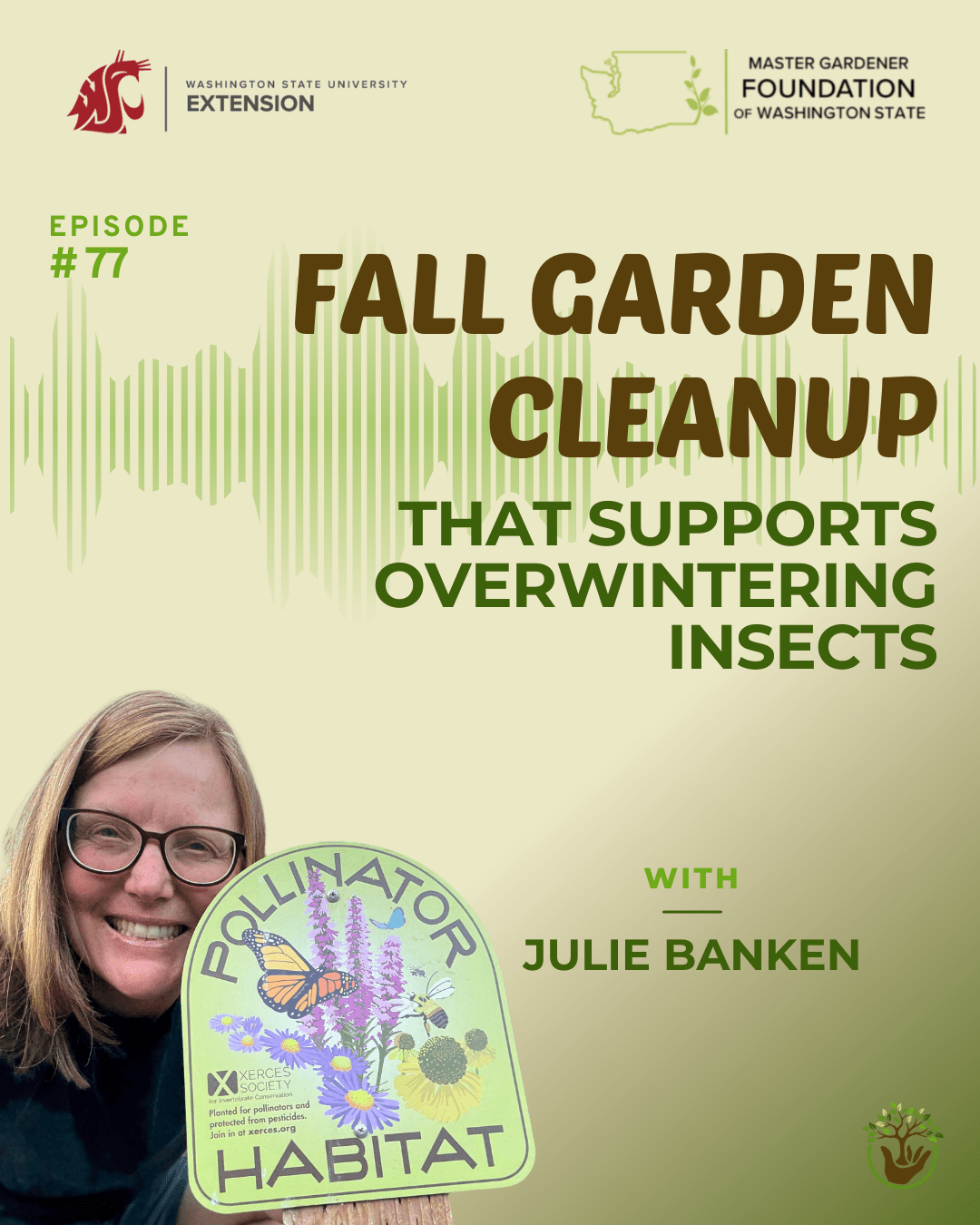
Master Gardener and Xerces Society Ambassador Julie Banken joins us to chat about actions gardeners can take during fall garden cleanup to help overwintering insects thrive.

Affiliate Disclosure: As an Amazon Associate, the Master Gardener Foundation of Washington State earns from qualifying purchases. When you buy through our links, you’re helping The Evergreen Thumb Podcast grow—just like good fertilizer! Product recommendations are our own and do not represent the views of MGFWS or Washington State University. Thanks for supporting us!
In this episode of The Evergreen Thumb, Erin Hoover chats with Julie Banken, a Master Gardener with a background in entomology, about creating pollinator-friendly gardens by rethinking traditional fall cleanup practices. Julie shares her passion for gardening with insects in mind, explaining how leaving leaves, stems, and other natural debris provides essential winter habitat for a wide variety of pollinators and beneficial insects. She encourages gardeners to view their yards as crucial parts of the ecosystem, highlights the importance of native plants, and offers practical advice for supporting insect life cycles—like leaving leaf mulch and standing stems through winter and only tidying up the next year. By making simple intentional changes, gardeners can help sustain the pollinators and insects that depend on them, making a positive impact right in their home gardens.
Julie Banken is a certified bug lady with master’s degrees in both entomology and education. She loves the insects as much as the plants in her yard and has made it her mission to inspire others to feel the same. She has taught science in the classroom and outdoors, and is grateful for the opportunity to continue teaching and learning as both a Master Gardener and a Xerces Society Ambassador. Julie is especially interested in garden ecology and the benefits of returning native plants to our communities’ landscapes. Look for her gardening column published monthly in the Wenatchee World.
Listen Now



Resources
- Website: https://extension.wsu.edu/chelan-douglas/mg-home/
- Facebook profile: WSU Extension Chelan/Douglas Counties Master Gardeners | Wenatchee WA
- The Xerces Society for Invertebrate Conservation
- About Five Seasons: The Gardens of Piet Oudolf
- Removing autumn leaves in residential yards reduces the spring emergence of overwintering insects (Science Direct)
- Legacy effects of long‐term autumn leaf litter removal slow decomposition rates and reduce soil carbon in suburban yards
- Doug Tallamy books: https://amzn.to/4h848vX
- Pollinators: Cultivating Resilient and Thriving Gardens
Transcript
Erin Hoover
Welcome to the Evergreen Thumb episode 77. My guest today is Julie Banken. Julie is a certified bug lady with a master’s degree in both entomology and education. She loves the insects as much as the plants in her yard and has made it her mission to inspire others to feel the same. She has taught science in the classroom and outdoors and is grateful for the opportunity to continue teaching and learning as both a master gardener and as a Xerces Society ambassador.
Julia is especially interested in garden ecology and the benefits of returning native plants to our communities’ landscapes. Look for her gardening column published monthly in the Wenatchee World
Erin Hoover (00:00)
Julie, thanks for joining me today. Welcome.
Julie Banken (00:03)
Thank you. I am really happy to be here. Thank you for inviting me.
Guest Introduction
Erin Hoover (00:08)
So, can you start off by telling us a little bit about your background and how that has shaped your perspective on how you garden?
Julie Banken (00:16)
Sure. So, I’m a certified bug lady. I’ve got the paper to show it. I have a master’s degree in entomology from WSU. Then I went into education, and now, as a Master Gardener, I get to teach people about insects, which is kind of my secret mission.
I love TED Talks, and one of the goals of TED Talks is to present ideas worth sharing. And so, an idea I have is what if instead of raising gardens for plants, we raise gardens for insects. And that has kind of informed my way of gardening, and that’s how I hope that other people will come to see gardening and what they do as gardeners.
Gardening for Insects
Erin Hoover (01:05)
So what is it about insects that made you decide you want to garden for them rather than just for the plants?
Julie Banken (01:12)
Well, plants are amazing, first of all. It’s not that I don’t like plants. There are so many interesting things that they do, and you know, of course, they’re beautiful, but the insects, once you learn a little bit about insects, it’s hard to stop. They really are an incredible addition to the yards that we have.
And the more you learn about them, the more fascinating they get. And I know that in just our culture, we grow up being told that bugs are creepy crawlies, or you know, icky things that we need to get rid of, but really, they are probably the most important group of animals that we have on this planet, and we just need to rethink the idea that insects are problems.
One thing I know as a Master Gardener, I’ve really enjoyed helping in the plant clinics. And a lot of times you get these questions, the people will bring in an insect, or they’ll send you a picture in email, and say, “What is this bug? Then part two is: how do I get rid of it?” And what I really hope is that people change their thinking.
My way of thinking would be, what is this bug? And tell me more about it. What is it doing in my yard? And in a lot of cases, how can I help it? Because they really are so important.
Fall Cleanup with Pollinators in Mind
Erin Hoover (02:46)
So today we’re talking a little bit about fall cleanup and how to manage our gardens going into the winter season. So what does that really mean in a home garden, and how can those decisions affect insects in particular?
Julie Banken (03:00)
Yeah, well, I guess just like we think that insects are pests to be gotten rid of, well, fall cleanup is also something I think we need to rethink. Just the word cleanup alone implies that there’s a mess that we need to get rid of so that it looks clean again. But really, fall cleanup is a problematic word.
What we should do is give it a new name. And I was trying to think of a better name. The one that I came up with is just fall rest. And not only are we resting, but we’re letting our gardens rest for the fall and then for the winter because that’s really what the insects are doing. And insects and other arthropods, I should add, can’t forget them. But they are resting and just mostly in a state of diapause while they’re waiting out the cold weather and getting ready for spring.
How Insects Use Gardens During Fall and Winter
Erin Hoover (03:59)
How do they actually use our gardens throughout the fall and winter that the typical fall cleanup might affect?
Julie Banken (04:07)
That’s a really good question. And I think that’s kind of the heart of the matter is that insects are actually using the space that we have in our yards. We think of monarch butterflies. If we’re lucky to see them, we know that they are migrating insects, and painted ladies also do some migrating, and so do green darner dragonflies. So it’s kind of interesting.
There really are only those three in Washington that, that leave for the cold season; the rest of them stay here. And that means that they need a place to spend the winter. Your yard is their habitat. And it is really a matter of life and death to them. If they don’t have a place to spend the winter, then they won’t survive.
So what we can do as gardeners is, first of all, consider that that habitat is so important, and then do what we can to protect it because there are lots of ways to answer your question. There are lots of ways that insects are using the habitat that’s out there.
There well, there are so many; I’m not sure where to start.
I guess we could start with the leaves that fall. When the deciduous leaves fall from the trees, they create a beautiful layer of what we call leaf litter. And then there’s another word that we should probably rethink because the word litter itself implies that it really is trash. We need to get rid of it and clean it up.
But leaf litter- I guess if I were to give it another name, I would call it maybe leaf mulch, because that’s really what happens in nature: the leaves fall, and then they become a mulch that enhances the soil, adds more organic matter to the soil, feeds the small arthropods and microorganisms, and so it improves the soil.
The leaf mulch also creates this wonderful layer of insulation that protects the ground-dwelling insects and other small animals that live on the ground. And that’s where they spend the winter, under this protective layer of insulation. And of course, it gives them lots of places for them to hide from predators. But if you think about it, our winters, well, depending on where you live in the state.
Over here in eastern Washington, we get very cold winters, and sometimes when there’s no snow, it’s very bare, very dry, and very cold. So a layer of leaves provides a blanket for the life that’s trying to pass the winter. So leaves are very important.
Other plant material is the dry stems of forbs, plants that will die back to the ground in the winter. There is a landscape architect. He’s famous. And I got to see his film at the Yakima Symposium. His name is Piet Oudolf. He’s a Dutch landscape architect, and I just love his philosophy, and he chooses plants in his landscaping that are beautiful all year long, not just in the spring or in the summer when they’re flowering.
But they’re beautiful from spring all the way through the fall when they die and then in the winter when they’re left standing. They’re still beautiful. And I just really think that that’s an important concept is to choose plants that look beautiful throughout the year. Because if they’re beautiful, you won’t want to cut them down.
The fall cleanup, or the traditional idea that we need to cut everything back to the ground and toss it into the yard waste bin, is unfortunate because the life that is in those stems is the next generation of insects.
For example, there are stem-nesting bees that will spend their entire adult life building nests inside the pithy or hollow stems of last year’s plants.
So, all day, every day for weeks, they will go out and forage for pollen, they’ll come back to their nest and they’ll take that pollen and create a nice ball of what we would call bee bread and then they lay their eggs on that pollen and then they’ll seal it off with some sort of plant material or mud if it’s a mason bee. And then they’ll go out and do it again.
So back and forth, back and forth to pollen in your yard, and then they finally, probably have 15 or so eggs in a long tube that is a dry stem of a plant. And so if you cut that in the fall and chop it off at the base and toss it into your yard waste bin, the entire life’s work of a female stem-nesting bee has just been literally tossed into the yard waste, and there’s a good word- it really has been; it’s been wasted.
It’s a great loss because that is next year’s generation of stem nesting bees. And so, by taking care not to cut those stems in the fall but leave them standing, then next year in the summer or maybe spring, depending on the species of bee, you will have a new generation of bees to go out and pollinate your yard.
Leaving your dry stems standing is also good for other animals like birds that would love to feed on the seeds that are drying on this on the flower heads. So leave them standing for the winter, cut them though in the spring.
And there’s a specific way to cut them. If you think about it, you want to create a stem nesting habitat. So instead of cutting them to the ground, cut them 12 to 24 inches off the ground, and you can leave them at different diameters so that different species of bees will be attracted to nest in those stems.
The new growth will come up and fill in. You won’t even see the dry stems. So it’ll be a wonderful, sheltered and hidden place for the bees to create their nests. And then the following year, you could repeat. So you are helping the bees through, first of all, not doing anything, and then later cutting the stems to a height that fits their needs.
How to Support Critters in the Garden
Erin Hoover (11:29)
Are there other garden materials that maybe we should leave in place that help support critters in our gardens?
Julie Banken (11:36)
Yeah, in fact, if you think about it, the more diverse your habitat, the more diverse the life will be in your yard. So besides leaving a layer of leaf mulch and leaving the stems up, you can also add things to your yard like rock piles or wood piles, or even you can bring in a piece of a log.
Water features are nice. Something not too deep that is nice to have if it’s hot and dry. And if you’re thirsty, then the insects are probably thirsty too. Take care, of course, with mosquitoes. You want to change any dish of water that you have so that it doesn’t become a mosquito home.
One thing I should say about leaving the leaves is that it is hard to leave the leaves everywhere in your yard. If you have, you know a couple of inches of leaves that become matted and wet, they can block the sunlight and prevent the grass from growing back again, well, in the spring.
So you don’t want to have a super heavy layer of leaf mulch over your turf grass. A little bit is okay, but too much can be a problem. Also, if you have dogs as I do, you probably need a clear space so you can clean up after them. And when there are lots of leaves, it is difficult.
So I think what we can do is make a compromise with Mother Nature and give space to the yard that we do use, and we need grass too, but also be sure to leave space for Mother Nature.
There was a really cool study. There was a graduate student, I think in Maryland, and his name was Max Ferlauto, and he had the most elegant PhD project. He said that he did yard work for his PhD. And what he did is, you know, we have this idea, “Well, leaving the leaves is important because the insects need them”. Well, he actually tested that. And so his graduate work was testing the difference between the number of insects that emerged in a yard that had the leaves untouched versus the number of insects that emerged in a yard where they raked them up.
And so he found that there were 18,000 insects and other small arthropods per square meter that emerged over the following season. So if we leave even a small patch of leaves in our yard, we don’t have to leave the whole thing completely untouched.
You know, we can tidy, we can tidy some of it, and still make a huge difference. I just think that’s such a wonderful way of showing that there really is truth to the idea that we should leave the leaves.
And another question people often have is How long do I have to wait before I can rake the leaves? The answer that he found in this study was that insects continued to use the leaf litter or the leaf mulch throughout the whole summer. They would actually go back to the leaf litter, and they would lay eggs in the leaf litter, and so more insects would come out of it. So it never ended.
So it’s kind of not the answer people want, because most people want a date, yes, or a temperature. You can rake the leaves when the temperature hits this certain number, and then you’re set, and you don’t feel bad, right? But unfortunately, that leaf litter is actually really important all the time. So just make a compromise with Mother Nature and leave the leaves where you can and rake them where you must. I think that’s really good advice and a good result from scientific studies.
Erin Hoover (15:48)
Yeah, that’s pretty amazing. I mean a square meter; that’s like ten square feet. And that’s a lot of insects in that space.
Julie Banken (15:53)
There are a lot of insects and just the multi-generation. Yeah, and he said he didn’t even count some of the little tiny ones like springtails and things, but there is a lot of life that we don’t even see. I mean, number one, most of it’s camouflaged because, you know, that’s to the insects’ advantage to not be seen. Number two, it’s very small often.
We don’t see the bees that are a few millimeters or moth chrysalises that look just like the dead leaf that they’re attached to or, you know, some caterpillars look like bird dung intentionally; that way they’re hidden from their main predator. So, yeah, leaving the leaves is important, but I certainly understand because I have to rake them away.
But instead of chopping them up with your lawnmower- because that chops up, you know, the insects too, instead of doing that, what you can do is you can rake them off to the side and put them in your flower beds, or you can use a leaf blower if you don’t mind the noise. But what I do is I just rake the leaves off to the side and let them settle.
It’s good if they’re wet; if they’re dry, they’ll blow around. I let them settle, and then they do become next year’s mulch, and keeps the weeds down, and keep moisture in the soil. And of course, adds really good organic matter and nutrients.
Insect Activity to Be Aware of in the Fall
Erin Hoover (17:28)
You talked about ground-nesting bees and insects in the leaf litter. What about some of like you mentioned, the chrysalis for the moths and butterflies, or what are some other insect activities that we want to maybe be aware of when we’re out in the fall?
Julie Banken (17:42)
Well, there’s no one way that insects overwinter. Some are adults, some are larvae, and some are still eggs. Often they’re in their cocoon or chrysalis, so they’re pupae. There’s no one way. It just depends on the species. It would be nice if we could say they’re all eggs, but they’re all different, and really, they’re so small, which is one of the reasons insects are so successful: they can go all over the place.
So, in any sort of nook and cranny, bark crevices, there are all kinds of insect life everywhere you look. But especially under the leaf litter, because that’s where it’s moist and warm and a very multidimensional space.
A lot of beetle larvae will be crawling around, and a lot of them are probably predators on a lot of other insects. So, it’s a whole ecosystem just down in the leaf litter.
Erin Hoover (18:45)
I was just thinking, like I occasionally get swallowtails, butterflies in my garden, and ‘cause they really like the dill. They love feeding on the dill. And so every year I have to be really careful when I’m out in the garden in the fall because every once in a while, I’ll find a chrysalis and usually they’re like on the side of my raised bed.
Julie Banken (18:52)
Mm-hmm. Yes.
Erin Hoover (19:08)
And so I’m always worried that I gotta pay attention to them. I’m afraid I’m gonna knock them off or something like that when I’m out there working.
Julie Banken (19:13)
Right. Wow, so how lucky is that? And they’re probably very camouflaged. Are they hard to see or…?
Erin Hoover (19:21)
Well, our raised beds are cinder blocks, so if you’re not paying attention, it’d be easy not to see, but I once I know they’re there, they’re easy to see, if it were wood or something like that, they would probably blend right in.
Julie Banken (19:32)
Praying mantis egg cases are another thing that you might see attached to a dry stem, the side of your house, or a fence post. Yeah, they’re also out there once you know what they look like; they’re a mass, but it looks a little bit like brown styrofoam or tan-colored styrofoam. Once you recognize them, then it’s pretty exciting when you know that they’re out there because they are really good garden helpers.
Erin Hoover (19:36)
Mm-hmm. Mm-hmm. Yeah, I do find those once in a while too.
Spotting Bumblebees Underground
Julie Banken (20:04)
How exciting to see a butterfly chrysalis. I wanted to answer your question again about things that are happening in the winter under the under the ground. My son and I were digging potatoes one year. We had left the potatoes probably because it was one of the warmer falls that we’ve had. And so we left them, and it was probably the end of October when we dug up the potatoes, and right next to this beautiful red potato was a bright yellow ball of fur.
And I had no idea what this is. Then we looked, it was a bumblebee. And that made no sense to me because it was a bee. Why is it under the ground? And so I looked it up, and sure enough, bumblebee mated queens are called foundresses, and they spend the winter a couple inches under the ground, all by themselves, in a state of diapause like hibernation, and that is totally normal.
So, if we hadn’t disturbed her, she would have spent the winter like that and then emerged in the spring to go start a new colony. But it was just such a surprise, and that was really what opened my eyes to all these other bees that we don’t think of when we hear, you know, save the bees.
We think of honeybees because they’re just like the red delicious apple. That’s what you think of when you see an apple and a honeybee is what you think of when you hear the word bee. But there are so many other kinds of bees, and they are mostly solitary.
The bumblebees are solitary only in the winter when the queens are by themselves under the ground then they have a colony for the summer so it’s kind of an annual colony but most of our bees and we have six hundred native bees just in Washington alone.
And they’re still discovering more of them that nest in the ground. So, like seven out of ten of them nest in the ground, and the others are stem nesters or cavity nesters, and they will nest in the material, and you know all around you. But anyway, it was a very exciting thing to see this bumblebee. It really opened my eyes to the importance of winter habitat.
Erin Hoover (22:43) You were talking about bees. Honeybees I get the impression they’re kind of unique in their living situation in you know as a you know as a colony in a hive as opposed to you know because the majority of our our native bees are solitary bees or like you said that the bumblebees are selectively in a colony, I’m finding that an interesting correlation that the majority of the bees native bees don’t live in the same habitat are in the same situation as what we normally think of as a bee. It’s the honeybee.
About the Honeybee
Julie Banken (23:17)
Right. Yeah. The honeybee really has stolen the limelight from all the rest of our native bees that are really important pollinators and also essential pollinators to some plants.
The honeybee is not native. You know, it came from Europe with the early colonists in Jamestown. And it is also the only bee that makes honey, and the reason for that is they are they don’t go into a state of diapause. They don’t hibernate during the winter.
They actually stay very active, but what they’re doing is they’re feeding off of honey. It’s their energy reserves. That is what sustains their colony as they stay warm by vibrating their wings. They have the queen in the center and they form this basketball of bees around her, and they vibrate enough to heat the hive up to like 90 degrees. It’s really incredible.
That’s why honeybees have to have, number one, a lot of bees, and number two, a lot of honey, in order to feed all these bees that are keeping the queen warm. And the queens can live like seven years under normal circumstances. That would be a healthy, healthy colony.
But all the rest of the bees. They don’t live through well; they live through the winter. See here, I’m doing it too. They are very much alive, they just aren’t active during the winter. They are waiting for spring either as adults or as either larvae or pupae, depending on the species. That’s why I get kind of tongue-tied is because there’s so many different bees and so many different ways to do it, but they’re mostly, you know, underground, waiting for the warm weather to come out.
Native Plants and Insect Life Cycles
Erin Hoover (25:15)
So, something you said about the pollinators and how some of them are specific to a plant, a native pollinator. So how do native plants support the insect life cycles beyond just the summer bloom?
Julie Banken (25:30)
That is such a good question. We have imported plants from all over the world because they’re beautiful, they have wonderful flowers, and also because a lot of them, like insects, just don’t eat. It’s really amazing. You can have this plant in your yard that insects don’t touch, like English ivy. Nothing can eat it. That’s because it came from somewhere else and the insects that would naturally eat it aren’t here.
So the plants that we have brought in as ornamentals are not feeding the ecosystem. They are just plants. The native plants have evolved over thousands and millions of years with insects that are native too.
And so they’ve developed relationships that are very unique, and they’re very dependent upon each other. And just like we can’t eat the rhubarb leaves, we can’t eat tomato leaves. Those the plants have chemicals in them that protect them from being eaten, and a lot of the plants that we have imported are inedible to a lot of our native insects.
So it’s really important to have the native plants so that they can feed the native insects. And the native insects are also pollinating the native plants. In some cases, they’re very specific to what plants they can pollinate. Some are generalists, but in some cases they’re very dependent upon each other.
Actions Gardeners Can Take to Provide Winter Pollinator Habitat
Erin Hoover (27:19)
So what are a couple of really easy actions that gardeners can take to provide pollinator habitat for the winter?
Julie Banken (27:28)
The easiest thing to do is really nothing, right? I mean, if you think about it, if instead of fall cleanup, if you call it fall rest, well, just sit back and relax because now it’s fall time and everything is is quieting down and you are actively, intentionally providing habitat for insects and other arthropods to pass the winter.
So sometimes you might need to put up a sign so your neighbors know you’re doing this on purpose and put up a sign that says leave the leaves; you know, pollinator habitat. And I think people are starting to recognize how it’s actually beautiful when you see a very natural-looking yard and you see all the life that comes to it.
Then you see the true beauty of having a natural space all year long. So that’s one action: no action. And then other things you can do, like I said, if you do need to rake the leaves in some parts of your yard, just save them and tuck them away in other places around your yard. Cut the stems in the spring, and you can save the stems too.
Don’t toss them into the yard waste because they might be occupied by native bees. So just save them for a while until the middle of summer. And you can even cut them and make them look very neat and tidy.
Final Thoughts on Fall and Winter Pollinator Habitat
Erin Hoover (29:10)
Do you have any final thoughts before we wrap up?
Julie Banken (29:15)
Well, I think it’s important to know that beyond insects, the entire ecosystem depends on the insects that are in our yards. And as gardeners, we actually have a huge opportunity to make a difference in the wildlife that is all around us.
If you think of how many homes we have now, you know, our urban footprint keeps growing and growing. But that doesn’t mean we have to take away the habitat entirely. We can add native plants and create habitat that still gives insects a home. It’s important not to use pesticides.
That’s a whole other podcast, I think. But Doug Talamy is an entomologist who has written really good books, so I really recommend looking into his books. One of them has inspired me so much, he has found that 96% of our songbirds and birds that live on land need to have insects to live.
And we think, well, you know, they eat seeds. Why do they need insects? But it turns out that they actually, even if they eat seeds as adults, they need to have caterpillars, soft-bodied insects, and spiders to feed to their young because they’re protein-filled, they’re soft, and they’re easily digestible. And I looked it up, and one nest of chickadees requires something like six to nine thousand caterpillars, which blows my mind because, I mean I don’t see that many caterpillars around here.
So that must mean in order to have one nest of chickadees, there are that many caterpillars at least. Birds really need a lot of food in order to raise one nest of their babies.
So we really do have this important role by allowing insects to exist and actually going beyond that to encourage them to exist. We are doing a favor not just, you know, to the insects, but to the birds as well. And then it just keeps going from there, so we really have an important role, and every one of us can make a difference.
Erin Hoover (31:52)
All right. Well, thank you so much for being here. This was great information.
Julie Banken (31:56)
It is my pleasure, and thank you so much for having me.