
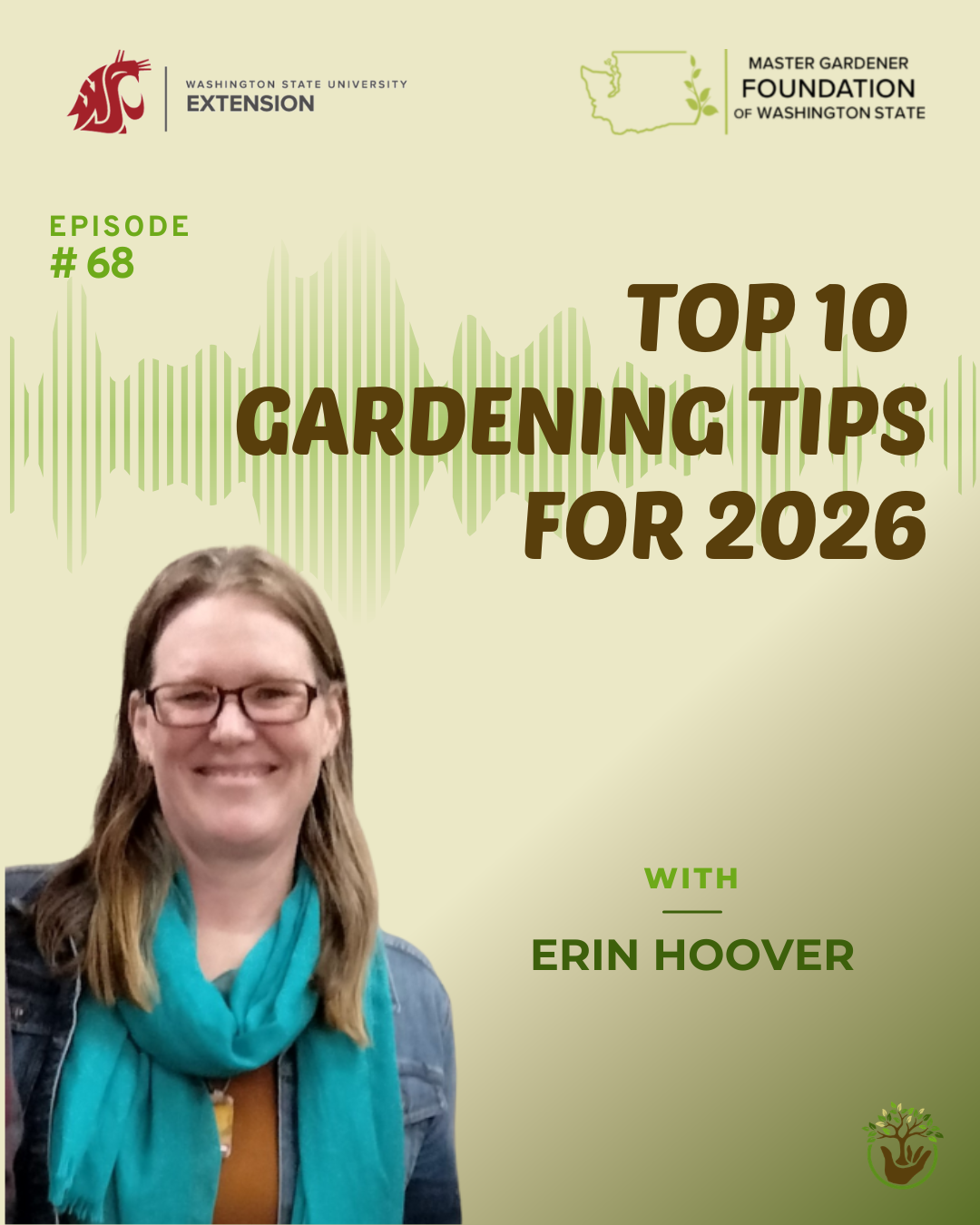
Top 10 Gardening Tips for 2026
Host Erin Hoover shares gardening tips that will help make your garden easier to maintain and more resilient in 2026.

Affiliate Disclosure: As an Amazon Associate, the Master Gardener Foundation of Washington State earns from qualifying purchases. When you buy through our links, you’re helping The Evergreen Thumb Podcast grow—just like good fertilizer! Product recommendations are our own and do not represent the views of MGFWS or Washington State University. Thanks for supporting us!
In this solo episode, Erin shares her top 10 gardening tips for 2026. These are practical shifts that can make your garden easier to manage while helping plants handle stress such as inconsistent water, pests, and changing weather patterns.
You’ll hear a mix of mindset shifts, common habits to stop, and a few practices worth adding to your routine. Topics include soil health, watering strategies, biodiversity in the garden, integrated pest management, and making site-driven plant choices.
Rather than overhauling everything, the goal is simple: choose one meaningful change this season and observe the results.
Erin has been a WSU Extension Master Gardener since 2015. She first trained in Skagit County, then moved to Grays Harbor County in 2016, bringing her gardening skills along with her. Growing up surrounded by Washington’s lush landscapes, she’s always felt connected to nature, which eventually led her to become a certified Master Gardener and Permaculture Designer.
As a homesteader, Erin has turned her own property into a small, thriving farm. She grows veggies, tends to fruit trees and shrubs, and raises livestock, all while following permaculture principles to keep things as sustainable as possible. Her focus these days is on finding new uses for native plants, figuring out ways to feed her animals from her land, and growing her own food.
When she’s not working on the homestead or recording The Evergreen Thumb, you’ll find Erin out exploring Washington’s mountains, forests, and beaches—always looking for ideas and inspiration to bring back to her garden.
Listen Now



Resources for Gardening Tips
- Sun Path View | Simple Solar Analysis – No Signup Required
- How to Read a Wind Rose
- Northwest Native Plant Guilds: How to Design Low-Maintenance Garden – Episode 62
- Designing With Nature – An Introduction to Permaculture – Episode 11
- Soil Health Made Simple: A Practical Guide – Episode 56
- Gardening for Clean Water: How Everyday Choices Impact Water Quality – Episode 59
- Soil Structure Secrets: Grow Thriving, Vibrant Gardens – Episode 60
- Better Together: How Plant Diversity Supports Garden Health – Episode 45
- Conserving Water In The Garden: What Every Gardener Should Know – Episode 52
Transcript of Top 10 Gardening Tips
Erin Hoover (00:00)
Welcome to The Evergreen Thumb, episode 68. Today, I’m going to talk about my top 10 gardening tips for 2026. Most gardeners aren’t struggling because they’re doing too little. They’re struggling because they’re doing too many of the wrong things, or maybe it’s habits that create more work.
Introduction
Most of us add new tasks every year; another fertilizer, another pest control, another tool, when often the biggest improvements come from changing just a few habits.
So it’s a matter of finding those highest-impact tasks to maximize your impact in your garden.
Think of the 80/20 rule. 20% of the things you do can have 80 % of the impact. So it’s a matter of finding those highest-impact tasks to maximize your impact in your garden.
So in this episode, I’m going to talk about some small shifts that’ll make gardening easier and more resilient for 2026. I’m going to talk about how mindset shifts reframe how you think about working in your garden, then I’m going to talk about things to stop doing in your garden, followed by some things to start doing that will help make your gardening and your garden more enjoyable.
Mindset Shifts for Resilient Gardening
So before getting into specific tasks or specific practices, it can help to shift how we’re thinking about our gardens. My first tip is to think about resilience versus perfection. Focus on systems that can handle stress, whether that’s heat stress, inconsistent water, or pests, rather than trying to control every variable. Keep in mind that native plants offer the best resilience.
And if you’re looking for something that’s a little more dramatic, choose what I call a near native. It’s a cultivar of a native species.
The only downside with a near native is it will not support pollinators in the same way as the actual native species.
It will likely have some of the same resilience as the native. For example, there is a species of Ninebark that has been bred for having deep red foliage and pink flowers, so it gives a little bit more dramatic look. It still has that nice kind of peeling bark of the native species.
So, things to consider in a vegetable garden, resilience would be having irrigation set like a drip system rather than overhead watering, so you’re minimizing your evaporation and maximizing the water that actually gets to the plants.
Or put it on a timer so that way you don’t forget to water and avoid that less consistent watering that can cause stress. So those are some options to think about in how to create resilience in your garden.
I’m also going to link to some episodes that kind of dive a little bit deeper into some of these topics.
And as far as native plants and resilience, I’m going to recommend episode 62 about some native plant options, and I will link to that in the show notes, and you can find the link to those show notes either in the description of this episode or on our website on the episodes page at theevergreenthumb.org.
Site-Driven Decisions in Gardening
Now, my second tip is about site-driven decisions.
Site-driven decisions include sun patterns, soil type, drainage, and exposure, and your plant choices should be guided by those factors more than inspiration photos or trends in plants. So it’s really key to observe your site for exposure.
There are apps or websites out there that help track that data. I’ll have links in the show notes as well for this. There’s one that’s called Sun Path View, and it actually maps out the sun at specific times, where the arc of the sun is based on your address.
For wind exposure, you want to look for a wind rose, R-O-S-E, like the flower, that will show you the sectors the wind is coming from, where predominant wind is coming from at different times of the year.
I’ll have a link on how to read a wind rose. And for this, I recommend episode 11, an introduction to permaculture, because one of the core concepts of permaculture is observation and understanding your environment that you’re growing in, and doing what is known as a sector analysis.
And that goes in a lot deeper beyond just sun and wind.
But those are the two big ones that you really want to pay the most attention to because they’re going to have the biggest impact.
Accepting Loss and Integrated Pest Management
Then my third tip for a kind of reframe is accepting loss. A little pest damage or plant loss is not a failure. Think of it as feedback. Trying to eliminate pest damage often creates more work and can have unintended consequences.
So it’s very important to learn about integrated pest management techniques and to understand the concept of tolerance of some damage, and when you reach a threshold, you decide that you need to take action, and what kind of action you need to take.
It could be, if you have aphids on your roses, say, or on another plant that you’re concerned about, you could plant a trap crop, which would be a plant that is also very prone to aphids, but it can be sacrificial. So, nasturtiums are considered a trap crop for aphids. If you plant nasturtiums in your garden, the aphids that are already there will be attracted to that nasturtium instead of maybe another crop that isn’t as appealing or to another flower that’s not as appealing to those aphids.
So once you kind of change your mindset and start looking at your garden this way, a few common habits are going to start to stand out.
Habits to Stop for Better Gardening
I’m going to start with a few things that are probably creating more work than they’re worth. The first one is stop over amending your soil without a soil test. Adding compost, fertilizers, or lime just in case can create soil imbalances and actually create more problems than what you’re already trying to fix.
A simple soil test will give you a baseline and, oftentimes, give you very specific instructions on exactly what you need to add to your soil for it to be balanced. I go into a lot of this in episode 56, and I will link to that in the show notes. Check with your conservation district; often, they do some testing, or they will send it out for you and provide a very in-depth report of exactly what you need.
My second tip is to stop treating all insects as pests. Many of the insects you see in your garden are beneficial, or at worst, they’re neutral. And again, this is where your integrated pest management techniques come in, but also being able to identify the insects to some level.
Understanding, are beetles inherently bad? Are flies inherently bad in your garden? Not necessarily, so jumping to control measures too quickly can make pest issues worse if you’re treating for a specific pest. Depending on what you’re using to treat, you can be killing off the beneficial insects that help keep those pests in check
So it’s really important to work through the different levels of IPM to manage the pests in a way that has the least impact on other species.
For that one, I’m going to link to episode 59.
And then finally stop watering lightly and frequently. Shallow watering tends to lead to shallow roots and less resilient plants, especially as our summers tend to get drier and drier. A good general rule is about an inch of water per week.
And how do you know what’s an inch? Well, depending on your irrigation methods, the easiest way is to just take an empty tuna can and put it in your garden in an area where your drip, or your sprinkler, or whatever your watering system is, will get water to that can and time how long it takes to get an inch of water in that can.
And then instead of breaking that one inch of water up, into the daily or every other day, only break it up into maybe twice a week or even once a week, depending on how hot it is. If it’s hotter, you might split that into two or three watering sessions, but if it’s a little bit cooler, but it’s still dry, you’re probably fine with just once a week. I talk about this in depth in episode 52.
That nice, deep watering on a routine basis helps those roots get way down in the soil where they can actually reach different nutrients and reach some of their own water.
The other advantage of knowing how long it takes to get an inch of water, you can use that same tuna can in an area that doesn’t have access to irrigated water. So that if it does rain, you can measure how much water you got, or if you have a rain gauge, you can use that. Then you know how much time you need to water that week to meet the difference between what the rain was and what the plants still need.
So if you stop doing those three things, what do you replace them with?
Some Shifts to Enhance Gardening Practices
Now we’re going to talk about a few shifts that tend to make a more noticeable difference more quickly. The first is starting to build soil structure. I talk about this in depth in episode 60, but the keys are to keep roots in the ground when you can. You can use cover crops or living roots and to minimize disturbance. So avoid tilling when possible.
I’ve mentioned before, I cut my corn off at the ground after it’s done for the season to leave those roots. And so that helps maintain the aeration in the soil over the winter when it’s getting pummeled with rain.
Cover crops help build organic matter in your soil; based on the cover crops you choose can add specific nutrients to the soil.
Building soil structure helps create more resilient garden spaces.
The next one is to start planting for biodiversity, even in small spaces. Mixing up plant types, including flowering species and aiming for a continuous bloom to support pollinators and beneficial insects, supports a biodiversity of pollinators and plants.
I always include a few random flowers in my garden. I have violets that I planted a few years ago, and I have just let them self-sow over the years. So they’re in the paths, they’re in my raised beds.
Brightly colored flowers draw in the pollinators and the beneficial insects, along with what else do I have? Calendula, sometimes I do zinnias or marigolds.
Just kind of depends on what we have, and a lot of those, especially the violets and the calendula, will readily self-sow. Calendula was very prolific in my garden, so I don’t hesitate to pull it out because I’ve got plenty of seeds that I know are going to come back the next year.
Another tip is to group plants in the garden beds by water needs. If you have a native plant garden and they are all native to your local microclimate, that is going to be a very water-efficient garden, and you will need next to no watering once that garden is established.
If you have a vegetable bed pair based on their water needs. So, a fruiting plant, like a tomato, is going to need more water than, say, greens, they’re trying to produce a fruit. Now, greens still need water, but if you’re pairing them with other greens that have similar water needs, then you can adjust your watering in each area of your vegetable garden as needed.
And in some cases, that one-inch rule is not going to apply, like I said, if you have a native plant garden that is, native plants that are actually specific to your microclimate, you are going to need significantly less than an inch per week once it’s established.
Small Changes for Improvement
Now you don’t need to do all these things at once. I would encourage you to think about what one thing you could try this season.
Gardening gets easier when systems improve and small changes compound over time. So just pick one thing to try.
I’d like you to reflect on the last season, last summer, or last spring, what worked well in your garden, what didn’t, and what is one thing that you would like to change for this year that will hopefully make your garden and your gardening tasks more enjoyable.
If you look back at many of these tips, a lot of them come down to a similar idea: working with the system instead of trying to control it.
Healthier soil, better observation of your site, and supporting biodiversity all make the garden do more of the work for you.
Erin Hoover (15:00)
As I said, I will put links to all of the episodes that I referenced and possibly some that I did not in the show notes, so that you can reference those.
I hope you find this helpful and are able to implement just one shift to make your garden space easier for you to manage, either physically or mentally.
I’d love to hear what it is that you choose to change. So you can email me at hello@theevergreenthumb.org or contact us through social media at The Evergreen Thumb on both Facebook and Instagram, and you can tell us there.
Thanks for listening.