
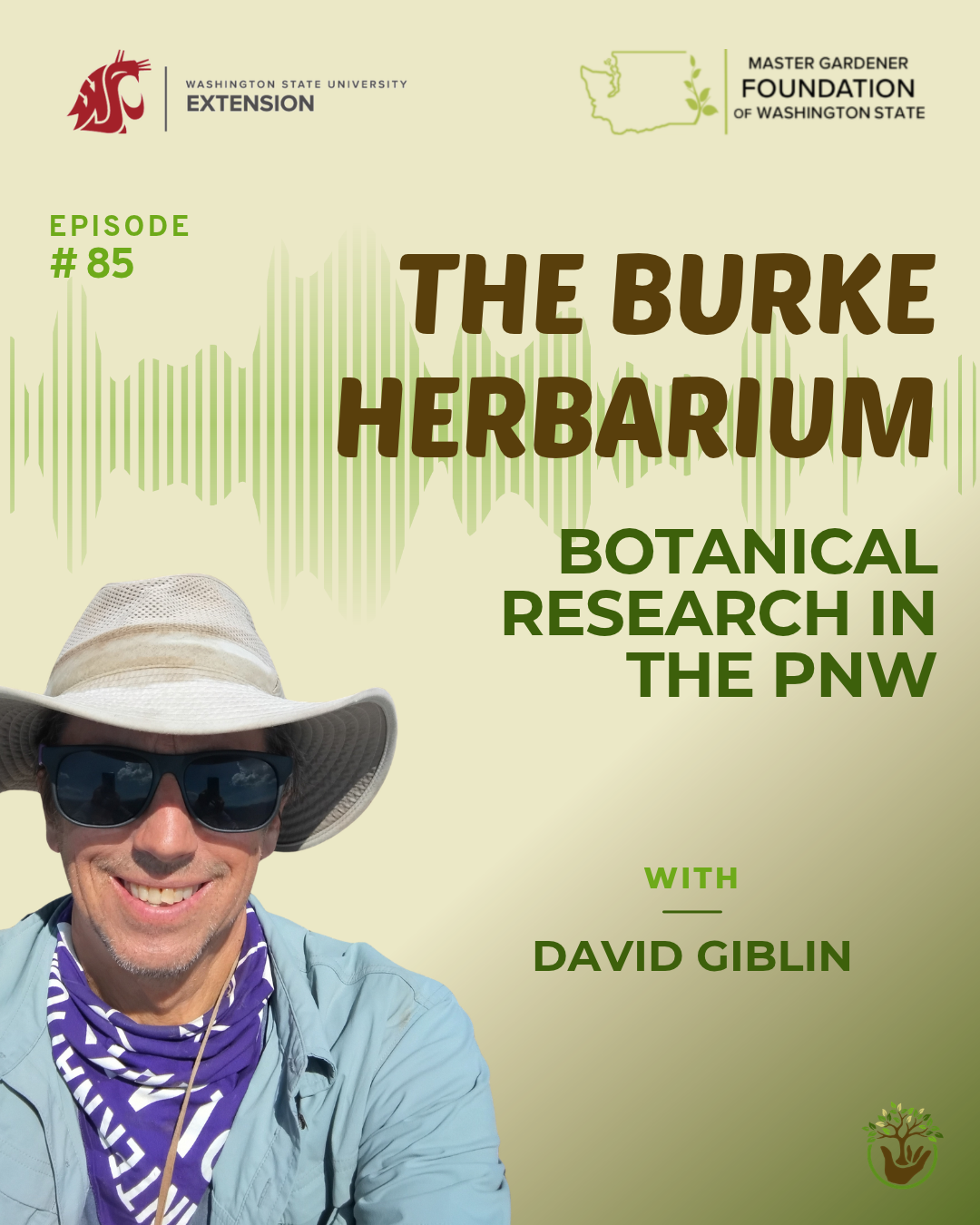
The Burke Herbarium: Botanical Research in the PNW
David Giblin of the Burke Herbarium joins Erin to discuss what exactly an herbarium is and how the Burke Herbarium documents plant, fungi, and algae diversity across the Pacific Northwest.

Affiliate Disclosure: As an Amazon Associate, the Master Gardener Foundation of Washington State earns from qualifying purchases. When you buy through our links, you’re helping The Evergreen Thumb Podcast grow—just like good fertilizer! Product recommendations are our own and do not represent the views of MGFWS or Washington State University. Thanks for supporting us!
In this episode, host Erin Hoover interviews David Giblin of the Burke Herbarium at the University of Washington. They discuss what an herbarium is, highlighting the Burke Herbarium’s role as a vital botanical research collection documenting plant, fungi, and algae diversity across the Pacific Northwest. David explains how the herbarium’s extensive specimen archive aids researchers, gardeners, and conservation efforts, and introduces listeners to valuable online resources like the Burke Herbarium Image Gallery and PlantQuest. The conversation also covers the importance of documenting both native and non-native species, how DNA analysis is reshaping plant classification, and the many ways gardeners can contribute to community science and deepen their connection to local plant biodiversity.
David Giblin is Collections Manager and Research Botanist at the University of Washington Herbarium of the Burke Museum. David’s research focuses on the distribution and diversity of the Pacific Northwest vascular plant flora, for which he has conducted extensive fieldwork throughout the region. He manages the Plants of Washington Image Gallery, Washington Flora Checklist, and Consortium of Pacific Northwest Herbaria online databases. He is lead editor and co-author for Flora of the Pacific Northwest, 2nd edition, and co-author of Alpine Wildflowers of Mount Rainier.
Listen Now



Resources
- Website: Plants & Fungi
- Burke Herbarium Image Collection
- Consortium of Pacific Northwest Herbaria
- PlantQuest – Burke Herbarium Image Collection
- Plant Lists
- Northwest Native Plant Guilds: How to Design Low-Maintenance Gardens – Episode 62
Transcript
Erin Hoover (00:00)
There’s nothing living in the Burke Herbarium, but gardeners can still learn a lot from it. That’s what we’re digging into on episode 85 of The Evergreen Thumb. I’m your host, Erin Hoover, and my guest today is David Giblin, who is the collections manager of the Burke Herbarium at the University of Washington.
Erin Hoover (00:17)
David, thanks for joining me today. Welcome to the show.
David Giblin (00:20)
Well, thank you very much, Erin, for inviting me. I’m flattered.
What is an Herbarium?
Erin Hoover (00:24)
We’re talking today about the Burke Herbarium. So can you tell us a little bit about what an herbarium is and ways that gardeners might use it?
David Giblin (00:31)
Sure, so an herbarium is a botanical research collection, and historically that has included plants, fungi, and algae. And then within fungi, that would be macro fungi and lichenized fungi. And so these are dried collections; there’s nothing living. They have primarily been put to use to document the diversity of these organisms within.
Generally, specific geographic areas and the distribution of that diversity. So they are, as I mentioned, dried specimens, and they are archived in many ways, the way you would a book in a library. They’re placed on shelves in particular places. And if somebody’s interested in looking at a specimen, then they can go to the shelf, take a look at it for their purpose, and return it.
We function like a library. We loan specimens out to researchers around the world who study those organismal groups, and similarly researchers here borrow specimens from other herbaria around the world in support of their research interests.
How the Herbarium Documents Our Plant Biodiversity
Erin Hoover (01:38)
Great. So, what’s the herbarium’s role in documenting Washington’s plant biodiversity?
David Giblin (01:45)
So the University of Washington Herbarium at the Burke Museum was started in about 1880. And this was an outshoot of what was then called the Young Naturalist Society. So these were folks in the late 1800s who were interested in documenting the biota: birds, mammals, fish, plants, fungi, and lichens. They started the herbarium then, and it has been at the University of Washington since that time.
The geographic focus of this herbarium is the Pacific Northwest in general, which for us is Alaska to Oregon, east to Idaho, and Montana. But more specifically, we focus on Washington. And so we have specimens in those organismal groups that I mentioned: plants, fungi, and algae that date back to the late 1800s, and we can have an idea of what is growing, where, when, because of these specimens.
And I’ll just give you an idea, an example. For those of us who live in the Seattle area, we were familiar with a place called Alki Point, which is in West Seattle, and it’s a lovely place to go when the weather is nice. We know that in the late 1800s there were oak trees there, there was camas there, there were wild onions there, because we have specimens in the collections that were collected by folks at that time. So, we know what the plant diversity was there before it was developed for residential purposes.
Resources for Home Gardeners
Erin Hoover (03:22)
Very cool. So, what are some of the online herbarium resources that are available to home gardeners?
David Giblin (03:29)
Well, I would think the online resource that we have that is most helpful to gardeners is the Burke Herbarium Image Gallery. It’s also known as the Plants and Fungi of Washington Image Gallery. But if you just Google Burke Herbarium Image Gallery, it will come up. As the name implies, it has both plants and fungi. So let’s just focus on plants because this is for Master Gardeners.
And so it’s a wonderful resource. It contains all of the wild-growing, native, and introduced species that have been documented by specimens here in Washington. Every species has its own page. It tells you what genus it belongs to, it tells you what family the genus belongs to, it provides common names, and it provides a distribution map for where each species occurs in Washington based on specimens and photos. It provides information about the habitat that it grows in and the bloom time. For many species, we have information about pollinators.
In terms of how it’s useful for gardeners, is that there’s a plant identification key as part of that website. So you can go to the plant and, I know plant identification, it sounds like you know, it’s so can be very technical and in some groups kind of challenging, but the interface for this plant identification key is non-technical.
It asks things that Master Gardeners would know. Is it a tree? Is it a shrub? A herbaceous perennial? Is it annual, biennial, perennial, or are the leaves opposite? Are they simple? What’s the flower color? What time of year does it bloom? And then what habitat?
So if I was, you know, when I think about my own home garden, let’s say I wanted to grow something, I wanted to choose something that grows in a forest understory and flowers in May and has white flowers. Well, I could go into that plant identification key and score those traits: I want white flowers in May for something that grows in western Washington forests. And then a list of species would come up, and you can take a look at it.
Or let’s say I had a wetland garden, or you know a rain garden, which are popular at least here in the Seattle area for managing stormwater runoff. And you’re like, well, what plants would do well under wet soil conditions? One of the habitat types is wetlands, lakes, and ponds.
So again, I could just score that. I could use a little box there to make sure I’m scoring the native species because that might be of interest. But at the same time, maybe someone likes Iris pseudacorus or, you know, yellow flag iris. I’m not promoting that people go out and plant it, but I also, you know, people are welcome to plant what they want. So yes, you could use that in my mind; you could use that plant identification key to select species that bloom at certain times of the year under certain habitat conditions.
What comes up is a list of species. You could click on the species, and then you can see what that plant is going to look like when it’s fully grown, when it’s in flower, when it’s in fruit, what the leaves look like, because every species page is supported by anywhere from five to fifty individual photographs that have been contributed by community members who’ve seen it in the wild or seen it in their garden, and they’ve uploaded photos that they think capture the growth form, the important identification characters of the species. So yeah, those photos are super helpful as well.
Erin Hoover (07:20)
When we bought property, I have five acres, and that’s what I used it to identify a lot of the wildflowers on my property.
David Giblin (07:24)
Nice.
Your question originally was about, you know, how it might be helpful to gardeners. And I was just thinking for choosing garden plants, but to your point, if you’ve got parts of your property that have wild-growing native plants or maybe non-native plants, then that would be a resource that you could use to help with plant identification.
And as you say, what’s nice about it is, you know, it gives you a list of the possible species based on the characters that you select. And we’re very visual creatures, right? This is how we experience the world. But for each species on that list, there is a thumbnail photograph, so you can probably narrow down the choices just by looking at the list about what the possibilities are, and then you can go ahead further and, you know, check each one. But yeah, it’s a great resource for plant identification.
Studying Native Plants in their Habitats
Erin Hoover (08:37)
We could also apply this to understanding habitats and how the native plants interact with their habitat as well, right?
David Giblin (08:44)
Yes, so you know, one of the things I do in my work is I go and collect specimens every year. Every year I probably spend about thirty days doing field work here in Washington, and by doing field work I’ll choose a part of the state for which we have few or no collections, and I will go out there, and I will collect not everything
For fairly common things, we know where they grow. But what I basically do is I collect all of the species in a particular area so that we have a good idea of all the species that are found in that particular habitat. So you know, in May, I might go over east of the Cascade Crest and further east of the Columbia River and collect in sagebrush.
And you would think that we know everything that grows in the sagebrush, but it turns out we don’t, because, you know, it’s a big state. There are large sections of it that haven’t been characterized in terms of the species composition. And so having a comprehensive, systematic way of documenting the diversity in these habitats gives us information about plant communities.
And I’ll tell you this. In my fieldwork, I have found species that have never been described, that are new to science. Here in Washington, and you know, these things are, if you saw them, you’d say, like, wow, that’s a pretty showy plant. How is it that nobody saw it before? Sometimes it’s because they didn’t get to these places before, and other times they are challenging to separate out from other species that we’re more familiar with.
So yeah, through the act of collecting, we’re able to do a better job of documenting diversity and then looking closely at that diversity and making sure that we’re not overlooking unique species that just by chance happen to look very closely, you know, in appearance to things that we’re more familiar with.
And in that context, we call them cryptic species. These are species easily confused with others. As I say, you would think after 200 years of plant exploration- you think about Lewis and Clark were here in Washington in the early 1800s, about 1805, let’s just say. So it’s 220 years of people doing plant exploration. We still haven’t found everything.
Studying Non-Native Species
And then the other thing I wanted to mention there’s two other aspects of that is one is non-native species. While we’re not excited about them being in our natural habitats, they occur there. They are part of the flora. New non-native species arrive here at a fairly regular interval for a variety of reasons. They’re escaped from horticulture. They are, you know, inadvertently introduced through construction. They are escapees; they’re in seeds of agricultural settings and become established.
So it’s important that we locate those new non-native introductions because some of them can be particularly invasive. And you know, the state of Washington has a very good noxious weed control board at the state level and then many of the counties have very active county weed control boards. And so we share that information with them.
They share their information with us because they’re out on the ground looking for stuff. Yeah, it’s a great relationship. So characterizing the potential threats to these native plant communities through documenting introduced species, non-native species, yes, that’s an important part of our work as well.
Exploring Regional Plant Diversity
Erin Hoover (12:49)
Right. You kind of alluded to this a little bit, but using it to explore some of the regional plant diversity and say, okay, what grows in this region versus this region and based on the habitat or whatever other factors.
David Giblin (13:04)
Yes, so you know, one of the things that our work is very helpful in doing. In my work, I really focus on species-level information. I collect species in locations around the state, as I mentioned. But there are people like plant community colleges who work for the Washington Department of Natural Resources who look at the distribution of those species, and they look at it in a more holistic way and at the plant community level, and it helps inform their characterization of plant communities across the landscape.
This is outside of my area of expertise and somewhat, you know, was when I first started doing it novel to me that there are rare plant communities that the Natural Heritage Program is documenting, tracking, and protecting based on the composition of particular species. And for them to know what the distribution of those species is within the state helps inform their conservation efforts, their prioritization of plant communities to visit and sample.
An Ever-Changing Subject
So yeah, and the other thing I wanted to mention is that I think I’ve alluded to this in a couple of different ways, but you know, the flora is dynamic. It’s constantly changing. And the only way that we capture those changes is through constantly sampling. I’ll give you a great example of Mount St. Helens. I’m sure there’s people listening to this podcast who remember when Mount St. Helens had an alpine area.
Of course, in 1980 there was that eruption, and that alpine area no longer exists. However, we have specimens here in the herbarium from Mount St. Helens’ alpine area, so that we have documentation of what used to occur there. In light of climate change, we expect the plant communities here in Washington and the composition of our flora to change.
Because as it becomes warmer, as it becomes drier, as it burns more frequently, these all have consequences for those plant communities. And so the information that we have is useful, while I don’t track those changes myself. People use our information to explore those ideas and those trends and those patterns in quantitative ways.
And this is a really important point about the specimens. Again, they’re scientific data. Someone can come in and take a look at them and say, okay, I agree, that’s what this is. Or someone can say, no, that’s incorrect. That’s this is a misidentification, and they can correct it. But you know, it’s tangible evidence. And we know where it was, when it was collected, and what it is.
It turns out that those are powerful insights when you want to explore different questions and things that you, in some ways you can’t do with just photos. Photos are helpful. I’m sure many of you know iNaturalist, and iNaturalist is helpful for documenting diversity across the state. But you can’t extract DNA from those specimens, and you can’t extract isotopes to look at different CO2 levels and other things. So yeah, these specimens can be used in really a variety of contexts.
Helpful Findings from the Herbarium Collection
Erin Hoover (16:47)
Can we talk a little more about the value of some of the findings that have come out of the specimens in the collection?
David Giblin (16:55)
Yeah, so you know I’m fortunate enough that I use the specimens every day to address questions that I have. We talked about invasive species; that’s one area that I’m interested in. One other area I’m interested in is what are the species of plants that only occur in Washington? And how are they distributed across the landscape?
And so there’s a term that’s used to describe species that occur in a geographic area, and that’s called endemic. The issue is that the scale of endemic is determined by the user. So, you could say it’s endemic to North and South America. Some people might use the term New World. You might say it’s endemic to North America. You might be endemic to Washington, and that’s the scale that I’m interested in. So which species of plants are endemic to Washington? And where do they occur? So by virtue of having these specimens and collecting on the landscape, I know that there are 87 species, subspecies, and varieties of plant that occur in Washington and nowhere else.
And I can tell you that the greatest abundance of those endemic species, subspecies, and varieties occurs in the Columbia River in central Washington. I just became interested in this topic, and I started doing fieldwork, and I started looking at historic specimens and looking at distribution patterns and trying to figure out why that is.
You know, without those specimens going back to the late 1800s, it would be hard to address that question about endemics. So we know that there’s a whole bunch of endemics out on the Olympic Peninsula, the east side, particularly, like Port Townsend, that side through Quilcene. That’s the rain shadow of the Olympic Mountains. It has unique geology. It has, for those of you who are interested in geology, this Arc of basalt.
So that’s one area, the Wenatchee Mountains in central Washington, between Snoqualmie Pass and Ellensburg. There’s again distinctive geology. There’s a high number of endemic plants there. The Columbia River Gorge, down around Goldendale, if people know that area. So, and then the Columbia River.
Well, there’s one more. The Blue Mountains in southeastern Washington. But you know, each one of these places has unique environments, whether it’s precipitation, geology, or historic events. You think about the Columbia River in central Washington; there are the Ice Age floods that people are probably familiar with. Again, you can’t address those questions unless you have specimens from those areas.
Another area that I’m interested in is alpine plants. And so, I’m very interested in the diversity and distribution of alpine plants in the Cascade Range here in Washington. For my purposes, the alpine zone of the Cascade Range goes from the Goat Rocks, which is just south of Mount Rainier, up to the Canadian border, and I stopped there because, you know, I need a passport and other things.
But you know, alpine areas are thought to be particularly sensitive to potential climate change going forward, with warming. And I thought, you know, wouldn’t it be nice if we had some baseline information about which alpine species occur where at this time, because that baseline data didn’t exist. So students and I visited over the course of five years, fifty-five peaks across the Cascade range to document diversity and the distribution of that diversity in the Cascade range to serve as baseline information. So, you know, there’s just all kinds of questions that we can look at by using specimens.
I’m in the process of describing two new species. They’re in the genus Allium, onion. We’re all familiar with onion. They turn out to have showy flowers. But for whatever reason, these two species have been overlooked, and again, without the specimens we couldn’t solve that problem either.
Erin Hoover (21:45)
Where did you find the Allium?
David Giblin (21:47)
In the Columbia River. In that area I mentioned that has this high number of endemic species. And the part that I’m talking about, if people are familiar with central Washington, they might know the town of Pateros, where the Methow River comes in in the north, and then the Tri Cities area to the south. So one of them occurs between Yakima and Ellensburg, and then the other new species is essentially between Leavenworth and the town of Entiat.
Erin Hoover (22:21)
Wow. It’s a pretty narrow range too.
David Giblin (22:24)
Yes, they are. What we can do now that we can extract DNA from plants and animals as well is extract DNA from these species, and then we can begin to look at some other molecular-level, DNA-level phenomena that might tell us a little bit about when these things arose over time. I mean, are these species 50,000 years old or a million and fifty thousand years old? We can get at that with the suitable amount of information. Who are their closest relatives? So for example, it could be maybe the closest relative of these species is in California. And that would not be unreasonable.
Well, I don’t think that’s the case; that pattern has shown up in other groups. And again, because once we have the specimens, we can extract the DNA, and then we can build these family trees, and then we can start to look at, based on DNA, we can start to look at who their closest relatives are, and then you know, address stories of dispersal and how things get around.
Common Ways Plants Spread
Erin Hoover (23:42)
That leads to a new question I was going to ask: when there’s several thousand miles between a species and/or a specimen and its nearest relative, has it usually been introduced through transportation, or is it a fluke, or do we even really know?
David Giblin (23:56)
That’s a great question. And I’ll have to answer it separately for native and introduced species. So let’s talk about natives first. One of the great mysteries is: how do things get around? You know, we’re at a disadvantage because we can’t turn back the clock, right? And see how things were 50,000, 100,000 years ago. So we have to fill in the blanks.
Let’s just go talk about the allium. People probably have grown onions at home; they flowered, they saw the capsule, the capsule is papery, it opens up, and these little black seeds fall to the ground. Well, how do these seeds get a thousand miles? Some of these species have distributions that are a thousand miles wide, right? How do these things get around? This is a hard question to answer.
I mean, if something is a fleshy fruit, let’s just think about our native apple tree, Malus fusca. You can imagine a bird eats an apple or a deer eats an apple, a bear eats an apple; they walk around, and it’s easy to imagine how those seeds get around. But the dry seeds like onions and some of these other things, yeah, I don’t have a good answer.
But over a long enough period of time, they do get around large distances: non-native species, introduced species. So I had again, I this is another research interest of mine. I was like, well, where did the non-native species in Washington that are part of the flora, that are self-reproducing, established, where do they come from? I mean, I had a basic hypothesis that the climate warmed and things just kind of moved up from the south, from Oregon into Washington. So colleagues and I looked at herbarium specimen data going back a hundred years to try to figure out where these things come from.
For Washington, west of the Cascade Crest, most of our non-native species were first documented in California, and they made it here through the ornamental horticulture trade. The reality is they got here by truck, they got here by train, they got here in people’s cars. So some species, particularly introduced species, make their way around through the assistance of humans.
The native species, they generally are not assisted by humans. I said species west of the crest for the introduced species. East of the crest, like in eastern Washington where there’s so much agricultural production, most of those weeds came in not from California, but from other places as part of, you know, seed being brought in to grow crops. And maybe, you know, they grow the seed crop in Idaho or in Montana and then, you know, maybe it was in the Midwest, I don’t know. But yeah, it was it really split out between the east and west part of the state in terms of the origin of those introduced species. But again, we couldn’t have done that without the specimens, because there was no iNaturalist a hundred years ago. There was no iNaturalist 20 years ago.
So having this deep time record of diversity and distribution is so helpful for addressing any manner of questions. And also, you know, this is another example I often give to people. When the students come by for a tour, I give them a quiz because that’s what they’re here for, right? And I’ll ask them, when was DNA described? And you would think, like, I mean, I don’t know, I had to know that when I was in high school. It’s kind of an easy question.
It’s the 1950s, and then you would say, well, when was the ability to extract DNA from plants and animals developed? It was like 1980; 80% of the specimens in this collection were collected before DNA could be extracted from those tissues. And now we have that technology, and we can pull out all kinds of information and address all kinds of questions. I guarantee you, 50 years from now, there will be new technological developments that’ll allow us to pull additional information out of these specimens we’re collecting today that we had no idea that they would be used in that context.
And I’ll give one other example. You know, more than 80% of this collection was made before the internet. People never envisioned that their specimens would be in a database and you could just sit down at your computer at home and access all this information. And so yeah, that’s in part what it keeps us well, there’s a lot of things that keep us inspired. But knowing that these specimens will be used in ways we can’t envision is really an important reason for continuing to build these collections.
The Reclassification Process
Erin Hoover (29:38)
So you were talking about the DNA. Have you ever had the DNA of a specimen that needed to be reclassified because the DNA more closely matched a different family or different genus?
David Giblin (29:51)
Yes. So my former boss; his name is Dick Olmstead. His research was based on DNA. And I’m sure many people who associate with the Master Gardeners are probably familiar with a family called the Scrophulariaceae, the Fig Wort family. It used to have all manner of things in it. Penstemon was in it. And that’s probably the plant that people are most familiar with.
But anyway, on the basis of his DNA studies, it turns out that the Scrophulariaceae had a whole bunch of genera that were in the wrong place. And, you know, before Penstemon was lumped in with digitalis, you know, purple foxglove, and was lumped in with Buddleia and some other things.
So on the basis of those DNA studies, it led to the reclassification of that entire family. It got split up into, you know, 5 or 6 different families. And I’ll give you another example. We all know the lily family, Liliaceae. I mean, I learned it as one family. And today that has been broken up into 12 or 13 different families.
I use those Scrophulariaceae and Liliaceae examples because those are things that people are likely to be more familiar with than, say, a species of a genus they may not be familiar with. But the answer is yes. And it’s I know we’re talking today about plants, but as I mentioned, fungi are part of our collection here. And today all of the classification work is done on the DNA of fungi because it’s far more informative than the morphology, the parts that you can see, whether it’s macroscopic or looking at a microscope. So DNA evidence is completely revamping our understanding of species and genera, which is the plural of genus, for mushrooms.
Plants, it’s not quite as easy, but still, kind of the go-to approach now is, hey, let’s extract DNA and see if it’s different than anything else. Yeah.
Erin Hoover (32:17)
Yeah, who would have known in 1980 that it would get used at this scale?
David Giblin (32:21)
I know. And you can’t believe the cost and speed of generating that knowledge has just plummeted. It’s cheaper than it’s ever been; it’s faster than it’s ever been. And you know, it really, it should continue that way. And you know, they talk about having the technology; I mean, I don’t have a crystal ball on how fast technology. But people have seriously talked about having a handheld device where you could swipe a leaf across the surface of it and get, you know, some DNA analysis of the tissue. So that’s kind of the holy grail and where people are moving. And when we get there, I can’t foresee it, but I’m optimistic we’ll get there.
And wouldn’t it be nice? I mean, really, people love having a name for the things that they’re looking at. And if that’s where they stop, that’s awesome. But oftentimes that’s just a gateway for people to learn more. Now I know what it is. I wonder more about where it came from and some other aspects of its biology. How do I grow it in my garden? Where will I see it if I’m out hiking? Who pollinates it? You know, are there birds that come in and visit it? So yeah, I feel like knowing the names of the plants around us is super helpful. I think it gives us a sense of place as to where we are.
Erin Hoover (33:55)
Mm-hmm.
David Giblin (33:55)
Just in a way you could say like, knowing the names of the people around you often makes you feel like, okay, yeah, I’m part of a community. I feel that oftentimes people feel that way about the green world around them.
How Gardeners can Contribute to Community Science
Erin Hoover (34:11)
So what opportunities are there for gardeners to contribute through community science opportunities?
David Giblin (34:17)
Well, that’s a great question. And I would say from the herbarium’s perspective, I mentioned that image gallery. That image gallery has over 100,000 images of plants that have been contributed by over 700 photographers. So if one visits that website, there’s a little bar at the top that says contribute, and there are instructions there for how
one can share photos through that website. Mostly it directs you to contact me to get further guidance. But yeah, so you know we love having people share their plant photos with us. We prefer that they be from wild settings because the images are linked to geo coordinates embedded in the image. And so if you have, like for some reason, let’s say someone was growing sagebrush in their front yard and they take a photo of it and it gets plotted in King County, that’s a bit of a problem. It’s best to submit your photos, and then if there are issues, we can address them in some way.
But yeah, that has been a great way. You know, I had a project that got started with a master gardener out in Jefferson County. And she was wondering, like, what can we do? So I said, Hey, you know, it would really be nice if you all could find photos of species that we expect to be in your county, but for which we have neither a photo or a specimen, and that list is generated basically by what occurs in the adjacent counties.
And so we create a project called PlantQuest. If you go to the image gallery website, you will see there’s a little header there that says PlantQuest. And then you can scroll down to each county and find out the list of species that are, I think we limit it to 40 species for each county for which we don’t have photos from that county, and we expect the plants to grow there. It goes back to what we started talking about at the beginning: distribution information. And boy, having good distribution information is really helpful. So that’s a great way for folks to share their images.
iNaturalist is easier to use just because their upload process is easier. So I would encourage people to think about contributing to iNaturalist as well. And you could contribute images to both, quite honestly. But yeah, I think that’s a great way. I mentioned earlier that I study the wild-growing plants.
We don’t directly do anything involved in the cultivation of native plants. So there are other organizations that do that and are really great at it. The Washington Native Plant Society is one of those. And they have some online resources about native plant gardening. And you know, I would encourage folks to take a look there and see if there are things there that they can contribute.
Yeah, I think it’s so important for people to share what they know in a way where it gets documented and archived and distributed because now we can do that with the World Wide Web. You know, collectively the Master Gardeners are this incredible resource of knowledge and experience. And yeah, it’s so important that that gets shared and archived, as I say, and made available for folks going forward because there’ll always be an interest in gardening with native plants. Why do you want to start from scratch? Why reinvent the wheel when you can use what other people have learned?
Erin Hoover (38:30)
Right. Yeah.
Tips for Getting Started with the Herbarium
So do you have any tips for getting started with the Herbarium’s resources for home gardeners?
David Giblin (38:39)
Well, I would just Google Burke Herbarium Image Gallery, and that’s the best place. I think that’s the place where people are going to find the information that’s most relevant to their activities. Learn how to navigate the site. You can search by common name, search by scientific name, and you can browse by common name and scientific names.
So, searching and browsing, you know, are two different approaches to exploring that information and seeing where it goes from there. Other resources that we have, but I feel like they’re kind of more technical, but I’ll just mention them because I use them all the time. We have a checklist for the flora of Washington.
And so that is a that checklist is what provides all of the names that appear in the image gallery. That checklist has the most up-to-date names as well as the previous names by which the native plants were known. And I’ll just give you an example.
Some people are probably familiar with monkeyflower. And so monkeyflower used to be in the genus Mimulus, but because of DNA studies, it turned out that that wasn’t the best place for it. Our native monkey flowers belong to the genus Erythranthe. That’s E-R-Y-T-H-R-A-N-T-H-E. So the checklist would have shown you Erythranthe for monkey flower, and then it would show you the species, the previous names by which Erythranthe went.
So that will be helpful. We also have what we call the Consortium of Pacific Northwest Herbarium online database. And so, this is a database funded by the National Science Foundation that brings together over 3 million specimen records and 1.8 million specimen images from 55 herbaria across the Pacific Northwest. And for that, you have to search by scientific name.
We can search on genus and species. There isn’t a common name search. And you can visualize the distribution of species based on the specimen records that are pulled back. But as I say that that that’s more of a technical resource, but at the very least it does give you an idea of where these particular species that occur here in Washington occur in the broader context. If one was interested and those kinds of things. But yes, I think of the image gallery, the checklist, and the consortium database as our three primary online resources.
But I mentioned the Washington Native Plant Society earlier. They have some other information that was pulled over from a place called the Starflower Foundation, which they made available online. But also we partnered with the Washington Native Plant Society to produce what are called the Washington Native Plant Society plant list database.
And so there are lists of plants for hikes around the state, hikes, parks, locations around the state based on people going out and recording what they see. So that would be a great place for people to contribute their insights. Either, if they’re on a hike, pull down a plant list and add to that plant list, or yeah, just use it for or create plant lists for places that aren’t in there.
Obviously, the plant lists wouldn’t be suitable to put a plant list from your garden. But you know, these are it could also be used again just to know which species occur in which part of the state, you know, at the county level and more local level.
Erin Hoover (43:02)
I can put links to the image collection to the consortium, and to the Washington Native Plant Society on the show notes, which will be on our website
David Giblin (43:10)
Okay.
Final Thoughts
Erin Hoover (43:11)
So everybody can find that there, or they can just Google it should come right up. Do you have any final thoughts on our chat today?
David Giblin (43:19)
No, I just want to thank you again for contacting me and asking me to talk about this. I’m, you know, I’ve been fortunate enough to do a series of presentations with the Master Gardeners on plant identification and learning the parts of plants. It’s such a great organization. It’s so important for promoting knowledge about plants in general, and not just cultivation of plants, but I think native plants as well.
So I just want to thank you and your colleagues for the great work you do. It’s just incredible how you bring people together around, obviously, a topic that I’m biased towards and that I prioritize. But yeah, I, you know, sometimes people are like: how can technology and plants coexist? Because they seem like very different pursuits, but you know, I think our online resources provide a way of, you know, leveraging the powers of technology to help people learn about plants, which I think is a great use of time and resources.
Erin Hoover (44:27)
Well, thank you so much for being here today.
David Giblin (44:29)
Well, thank you so much again. I really appreciate it. I’m flattered and honored to be invited, and if people have questions, they are certainly welcome to email me. I’m easy enough to find on the internet.