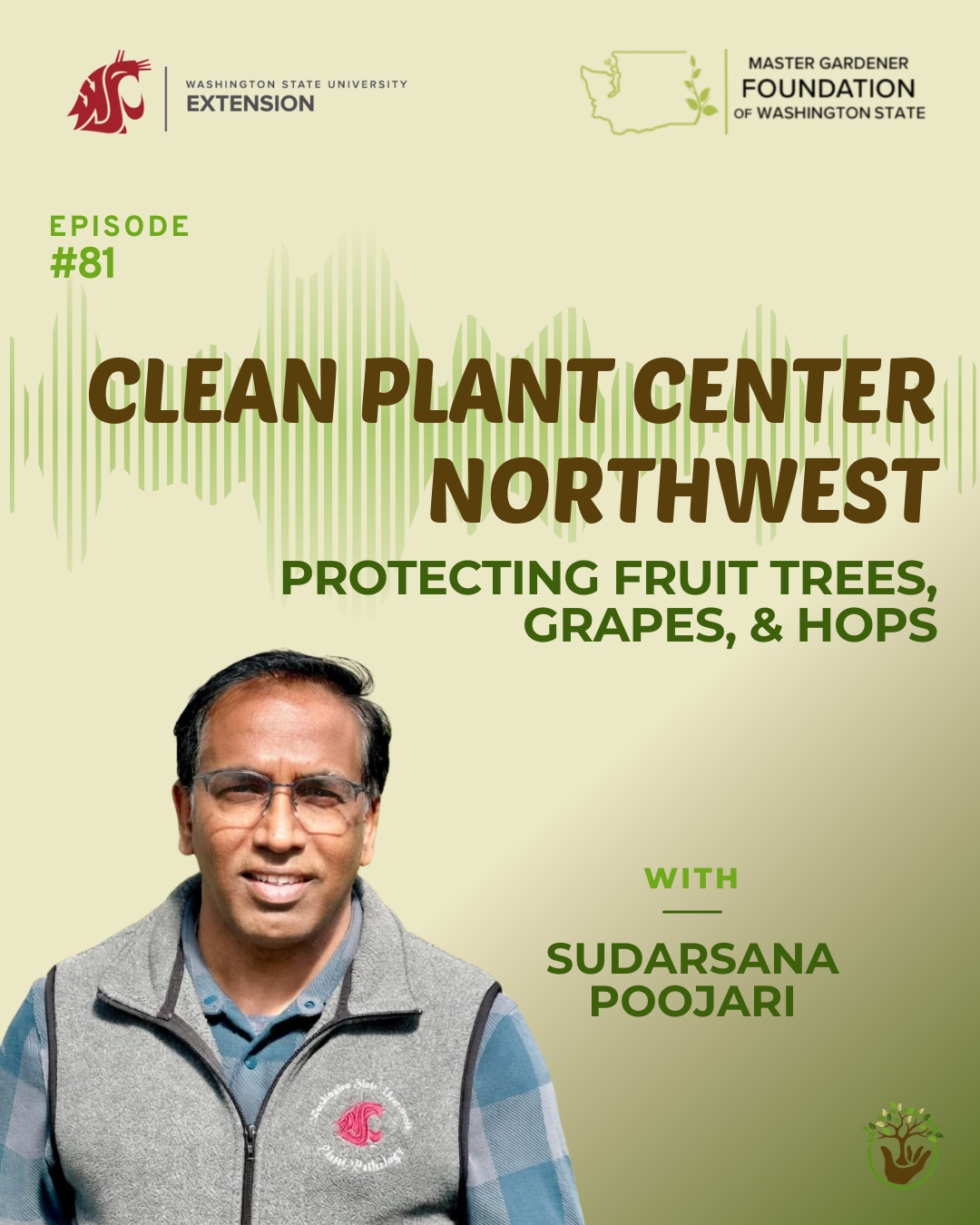
Clean Plant Center Northwest: Protecting Fruit Trees, Grapes, and Hops
Start Clean, Stay Clean: Director of the Clean Plant Center Northwest Dr. Sudarsana Poojari joins us to talk about how we prevent disease spread in our crops.

Affiliate Disclosure: As an Amazon Associate, the Master Gardener Foundation of Washington State earns from qualifying purchases. When you buy through our links, you’re helping The Evergreen Thumb Podcast grow—just like good fertilizer! Product recommendations are our own and do not represent the views of MGFWS or Washington State University. Thanks for supporting us!
In this episode of The Evergreen Thumb, Dr. Sudarsana Poojari, director of the Clean Plant Center Northwest at WSU Prosser, joins Erin Hoover to explain how his program tests and treats fruit trees, grapevines, and hops for viruses and other pathogens before growers and nurseries multiply that material. He walks through the process of diagnosis, treatment, and verification, discusses what home gardeners should look for when buying certified planting stock, and covers the challenges facing clean plant programs as pathogen and crop landscapes shift.
As the Director for CPCNW, Dr. Poojari is responsible for advancing the CPCNW’s mission of supporting the agricultural community through the production and distribution of pathogen-tested, virus-free plant materials, ensuring the health and sustainability of specialty crops. Dr. Poojari earned his PhD in Plant Pathology from WSU in 2013 and served as a Research Scientist in Agriculture at Agri-Food Canada and Brock University for over 13 years before re-joining WSU. His research focused on molecular diagnostics, epidemiology, and clean plant programs for specialty crops.
Listen Now



Resources
- Website: https://cpcnw.wsu.edu/
- Favorite social media profile: Clean Plant Center Northwest | Prosser WA
- Grapevine Leafroll Disease.pdf
- Grape (Vitis spp.)-Grapevine Red Blotch Disease
- NCPN
- Animal and Plant Health Inspection Service
- Local Food: Cultivating Skills for Sustainable Food
Transcript
Erin Hoover (00:00)
Welcome to The Evergreen Thumb episode 81. My guest today is Dr. Sud Poojari, who is the director of the Clean Plant Center Northwest. Dr. Poojari is responsible for advancing the CPCNW’s mission of supporting the agricultural community through the production and distribution of pathogen-tested, virus-free plant materials, ensuring the health and sustainability of specialty crops.
Dr. Poojari earned his PhD in plant pathology from WSU in 2013 and served as a research scientist in agriculture at AgriFood Canada and Brock University for over 13 years before rejoining WSU. His research focused on molecular diagnostics, epidemiology, and clean plant programs for specialty crops.
Sud, thanks for joining me today. Welcome.
Sudarsana Poojari (00:47) Thank you for having me.
The Clean Plant Center Northwest and What it Does in Agriculture
Erin Hoover (00:48)
Let’s start off with the big picture. What does the Clean Plant Center Northwest do, and what role does it play in agriculture?
Sudarsana Poojari (00:57)
All right, so the Clean Plant Center Northwest, we simply call it as CPCNW. It is a program based at Prosser Irrigated Agricultural Research Extension Center, IAREC; in other words, at Washington State University at Prosser.
So what we do, to put it in a simple word, think of us as a front-line defense for plant health. Our job is to make sure that the starting material for growers or nurseries that they use to propagate or to multiply in their foundation blocks or nurseries we make sure they’re free of some viruses or some other pathogens.
So we are part of a bigger collaborative network called the National Clean Plant Network or NCPN, which brings together different universities across the states and the US Department of Agriculture, as well as the industry groups that do represent the specialty crops like fruit trees, grapevines, and hops.
So why only these crops? When I say USDA definition of specialty crops, these are the crops that are propagated vegetatively, which means we have to take a cutting or a graft, or a tissue culture-raised plant to multiply further. So into like one mother plant can make into a hundred, thousands of plants through propagation.
Because of this propagation, there is a risk that if there is a pathogen inside these plants, that means it will carry through the daughter plants. So that’s why our role is really at this checkpoint. When we take the material, plant material in, we test it thoroughly, clean it up if it is infected, and then release what we call the foundation material.
Sometimes we also refer it as the generation one, like G1 plant material that the nurseries trust this material. So it’s a kind of kind of work that the most home gardeners or Master Gardeners probably not heard about before, but definitely it lies underneath a huge amount of work that the people who enjoys a great delicious fruit or wine or beer made with the Yakima Valley hops we probably are part of it.
Clean Plant Material
Erin Hoover (03:49)
You mentioned the clean plant material. What makes the material clean, and what is it that you’re looking for generally in those crops?
Sudarsana Poojari (03:59)
Right, that’s a that’s a great question. We do use the words the clean plant because it does sound good, first of all, but I have to emphasize a little bit on it because the clean simply means the plants that has been tested are shown to be free of specific pathogens. That could be viruses, viroids, phytoplasmas, or other bacterial infections, fungal infections, but these are the pathogens that really matter to that particular crop.
There are some pathogens that are allowed in the certification program because the science has shown that these are not the pathogens that could be causing significant damage or economically they are important. So, except those ones, the pathogens that really matter to that particular crop.
When I say tested or shown to be free, the clean isn’t a vague promise, but it is really a verified status. Why does it matter? Because as I mentioned, these are the pathogens that you can’t see with your with your eyes visually.
The visual symptoms for some pathogens might give some clues that this could be this, but that can be confused with any other pathogen, infections, or nutritional deficiencies, things like that. So based on the visual symptoms, we can’t really predict, okay, this is the pathogen. And a vine or a fruit tree, it might look perfectly healthy because it’s not showing any symptoms but might still be carrying a virus or phytoplasma inside. Then what it does is you know it will eventually gradually decrease the lifespan of the vine or of a fruit tree and makes it more vulnerable to other pathogens, for example.
And also eventually it will lead to poor quality of the fruit, which is the most important thing. So that’s the catch with these propagated crops. If the mother plant is infected, every cutting that you make or every graft you make with that material or even if you do a tissue culture propagation, all the offspring from that mother plant coming off can carry the same pathogen.
So the problem doesn’t just stay, but it multiplies over time. That’s why starting clean is very important, as our slogan says: you start clean and stay clean. So we are at the start-clean process, but there are eventually many more processes down the line.
As the Clean Plant Center Northwest, our foundation plant gives the growers a healthy baseline. So this baseline can be continued at the nursery levels, and good nursery practices down the lane keep that health status going. So in other words, I would say it’s a lot easier to protect a healthy plant than curing a sick plant.
Especially this is true for infections with viruses and phytoplasmas where once the plant is infected, there is no cure. So we have to start clean.
Pathogen Identification
Erin Hoover (07:39)
Alright, that makes sense. So, the pathogens that you’re looking for in this plant material, are they usually easy to identify or does it depend on the pathogen or the species?
Sudarsana Poojari (07:49)
It is always dependent on the pathogens. Because of the perennial nature of these crops, some of the pathogens depend on the variety that is being propagated or grown. Depending on the pathogen, whether it is a virus, viroid, they can show symptoms on some of the varieties more apparently than others.
For example, if I go very specifically, some hybrid grape varieties don’t show any symptoms for some of the major virus infections like grapevine leaf roll-associated virus or grapevine red blotch virus. Some of the rootstock, for example, on grapevines probably doesn’t show any symptoms for any viral infections. So that makes it very hard to rely on visual-based symptoms. That’s why detection testing is very important in the clean plant programs.
The Clean Certification Process
Erin Hoover (08:56)
Can you describe the journey of plant material from the time that it arrives at CPCNW to the time that you are releasing it as clean material?
Sudarsana Poojari (09:07) Sure. It’s actually pretty satisfying to walk through the process. It happens in three different phases. So the first one is diagnosis, and the second one is treating, and then we verify- that means we retest again before we either maintain in our repository or release it back to the nurseries or custom propagators.
When the material first arrives into the CPCNW, it may be a new grape variety or a cherry variety that a breeder just developed and wants to get introduced, or like a hop cultivar coming from maybe another state or another country. So first thing that happens is when the material comes in, we have to take it to a quarantine facility where first we inspect visually.
We have to follow this APHIS regulations based on the quarantine regulations. So we visually inspect it to make sure that it doesn’t carry any fungal infections that are very apparent to observe. We don’t really trust based on the visual, obviously we have to make sure that that particular plant material is first maintained at a controlled quarantine facility so that it can grow and produce leaf material, for example, or we can use the same if it is a lignified cane sample we can scratch and maybe take some of the live tissue and use it for testing.
So we test it for a bunch of pathogens that are on our list. It is again crop-specific. For example, grapes. There may be 25 to 30 different pathogens that we test. For hops, maybe there are 10 to 12. It all varies based on the host crop and then the pathogen list that we deem important.
So for testing, we use different types of diagnostic techniques. The molecular diagnostic techniques, like PCR, the polymerase chain reaction, or even more sensitive, more comprehensive techniques like high-throughput sequencing, which not only tells us the known pathogens but also has the ability to detect some unknown pathogens that we have some knowledge prior before. So once the testing is done, if the material comes back infected, then the therapy part comes in. So that therapy means that we employ different types of pathogen elimination techniques.
For example, for hops or grapevines, we do employ techniques like meristem or shoot tip tissue culture techniques, where we take the apical part of the shoot tip, cut it in a controlled conditions, and grow in an artificial medium so that that part is not having any viruses or viroids. Or we can also use thermotherapy or heat therapy, where plant material is subjected to a certain temperature for certain time or cryotherapy, where the plant material is subjected to, maybe like ultra-low temperatures. Again, these techniques, in combination or standalone, could work for some crops, probably won’t work for other crops. So we have standardized what works for what type of crop based on what type of pathogen, again.
We apply different types of these elimination techniques to try to recover a cleaner version of the same cultivar, for example. So I have to be very careful here when we do all these techniques to eliminate the pathogens, we are not changing the genetic footprint of the variety or a clone. That is very important for us so that if they submit Chardonnay clone 5, it has to stay Chardonnay clone 5, something like that. In other words, we are just stripping the pathogen out of the plant material.
So once we have done that process, we regenerate those plants because you have to prove that the elimination process has worked, so the whole plant goes to the retesting process again using PCR, high throughput sequencing to make sure that all the pathogens that that we are concerned about are not there in that particular variety.
Once we confirm that with the retesting, that’s where the plant enters into a maintaining process where we can retain and maintain in our controlled conditions, either in a greenhouse or a screenhouse that is protected so that the plants cannot get reinfected with insects that are capable of transmitting some of these diseases or pathogens, so that we maintain those plants and make sure that we have audit testing, visual inspections every year so that the plants that we maintain or release have the clean status.
So that’s the material that will finally end up with the nurseries for their further multiplication. This is the material that is called foundation plants or generation one plants.
So these are the material that goes out of my program and then, you know goes to the nursery or a custom propagator where they will use this material. These one or two plants will become maybe thousands down the lane. But they establish their own mother vineyards or fruit tree blocks or hop yards with this material, and that’s the material they use for propagation to scale up down the lane.
When it comes to certification for fruit trees, grapevines especially, the state certification program applies to those secondary blocks that have sourced this material from the CPCNW. So, the certification level applies there, where again there will be a little bit of audit testing and visual inspection by the state certification program on those blocks.
And if the final material, either it is generation two or generation three, G two, G three, or G four, typically what the material that ends up with the grower to plant a vineyard or a or a fruit tree block. Well, it’s the whole chain. So we are at the bottom of it.
What Clean Certification Means for Home Gardeners
Erin Hoover (16:19)
Okay, so what does this mean then for home gardeners or home growers who are buying plants at a nursery or a garden center?
Sudarsana Poojari (16:31)
This is my favorite topic to explain. As a home gardener or somebody who has a big backyard and wants to plant some fruit trees or grapevines or you know, hop plants and some berries. You are investing for years to come, or, you know, maybe decades.
You have to take care of this plant for years to come. So sometimes people plant it, they take care of the plant very nicely, but still see the plant is struggling. There may be a case that you know the problem has started well before you plant it. You know, sometimes it may be carrying a virus all these years. It might even have started before it actually ended up in a nursery.
So that’s why we always say, you know, for your peace of mind, any planting material that can trace back to the clean foundation material will have a better chance of growing vigorously, producing well, living long life. So, you are getting a healthy start if the plant material is coming from the foundation services.
That’s why I always emphasize to nurseries, small-scale growers, even you know, the Master Gardeners, that the material that you buy from a reputable nursery that is participating in the certification programs, you are benefiting from the whole clean plant system. Even though you haven’t seen it, the clean works that happened way long before the plant reaches to the nursery.
So again, choosing a certified locally sourced plant, and especially if it comes to the nurseries, being a little patient with the whole process of cleanup, I think is one of the smartest things that the whole industry can do.
Resources for Certified Clean Material Sources
Erin Hoover (18:30)
So is there a resource where gardeners can see if there are growers that use certified clean material, or they receive from growers that use certified clean material?
Sudarsana Poojari (18:41)
Yeah, any material that was coming from the foundation services like what the Clean Plant Center Northwest offers, the nurseries take that material, and they have a tag on them that it yes it is coming from the clean foundation services. That tag will carry all the way to generation four, which is a certified planting material.
So always ask nursery at the growers or who whoever starting the new vineyards or hop yards, to see those tags and buy the material from certified planting nurseries that are involved with the certification program. That is the key. So if there is always that the tracking, even with the generation four, G four tag, you can trace it back which particular plant that material has been multiplied thousands of times. We can trace back to one plant at our foundation services.
Fruit Trees and Clean Certification
Erin Hoover (19:45)
Wow. So you’ve mentioned hops and grapevines and fruit trees. I know that’s a lot of Washington’s key crops, so I assume that’s why you’re dealing mostly with those crops. Are there specific fruit crops that you work with more than others?
Sudarsana Poojari (20:05)
Well as the at the Clean Plant Center Northwest, of course, these are three big crops that we specialized on, as I mentioned; the grapevines, fruit trees, and hops. But when it comes to fruit trees, we cover all types of fruit trees. It’s not only apples, cherries, or pears. We cover all the stone fruits as well.
Why? Because these are hugely important crops here in the Pacific Northwest, especially in Washington state. So as we all know, we are major wine and grape region, and also are one of the biggest apple producers. Not to mention that we are the largest producers of hops. Most of the hop production in the country happens right here in the Yakima Valley.
You were asking whether we work on any other specialty crops; the answer is yes. Again, it depends on stakeholder needs and our program capacity. But again, what it ties all together is that these should be propagated crops, that the growers multiply through either cuttings, grafts, or tissue culture, rather than planting seeds. That’s the exact kind of system where a clean starting point matters the most because these pathogens can move through the propagation system.
Especially in the Pacific Northwest, if you are enjoying a delicious apple or Pacific Northwest IPA or Washington State wine, there is a decent chance that the CPCNW was part of how that particular crop stayed healthy and productive.
Again, we have capacity to expand it to other specialty crops, but it has to be, you know, stakeholder-driven. Demand should be there.
Number of Varieties in CPCNW Facilities
Erin Hoover (22:15)
I’m just kind of curious, how many different varieties or plant samples do you have in your collection?
Sudarsana Poojari (22:24)
Well, right now let me start saying how much capacity we have at our quarantine greenhouse and screenhouse facility. At CPCNW right now, we have close to ten thousand square foot of greenhouse facility and thirty thousand square foot of screenhouse facility to host all these fruit trees, grapevines and hop varieties.
Typically, the word that we use is accessions in the germplasm language. So right now, the capacity that we have in in our facility is close to 400 plus accessions of different fruit tree varieties. 400 plus accessions of different wine grapes or juice grapes, as well as the rootstock of grapevines, and close to 60-plus hop varieties. So we are looking at more than 1200 different accessions of all these crops altogether in our facility.
The numbers keep on changing because we do release these accessions once they are gone through the program. Some plants will take two years; some plants take more than two years to release as a clean plant material. You can see how many we have as clean material in our web portal cpcnw.wsu.edu; there is a list of all these varieties.
Any material that comes into the program, people can request through introductions or through our portal, and then get introduced and go through the process. People can also see what the stage of, you know, the cleanup process or testing process, the status of the whole clean process on our portal as well.
What Happens to Specimens After Clean Certification?
Erin Hoover (24:28)
Nice. So once a specimen has been, or once material has been certified clean, you continue to keep a specimen, or that’s just released to the client?
Sudarsana Poojari (24:38)
When I said we have twelve hundred plus accessions, we have those in our maintenance. So people they can order different type of material, like lignified canes in the winter or green cuttings or tissue culture shoots or green shoots or anything that they can order. We do maintain them here, but you know the landscapes are changing, the preferences changes. The foundation collection might even change a little bit.
But if there is a demand, one of my jobs is to track that progression in terms of what the preferences are, in terms of planting material, which varieties growers want; maybe they’re moving into different ones, a new variety came in, like Cosmic Crisp or, you know, Honey Crisp, people want to change it, and we have to make sure that that material is in the program and it is available for the nurseries to select from our programs.
How CPCNW’s Work Protects the Agricultural Industry
Erin Hoover (25:39)
How does CPCNW’s work protect Washington growers and the broader agricultural industry?
Sudarsana Poojari (25:48)
When it comes to the Washington growers, although I should potentially talk about the growers of Pacific Northwest because the center represents the Pacific Northwest; But you know, Washington growers are competing in a global market, and I would say the plant health directly tied to the bottom line.
So any virus-infected vine or a fruit tree can mean not only they cannot propagate well in the nurseries, but when they distribute infected planting material, it may end up into the into the growers’ vineyards or orchards. That can reduce yields or, most importantly low fruit quality. The lifespan of the vineyards or orchards can be shortened.
Not only that, the problem multiplies in the sense that, say, for example, if a new vineyard block planted with non-certified material and unfortunately is having some virus infection, it shows up maybe a couple of years later when you plant.
That means you’re already invested in the planting, and then you wait for your first production four years down the lane. By the time you realize that you know the plants are not producing well because they can’t even survive in some cases. So that means the economy of it, not only the cost of investment in planting a new vineyard, but replacing and then waiting another four years down the lane till it becomes productive. That’s a lot of risk if you are not careful in choosing certified planting material.
So that’s very important for not only Washington State growers, but, you know, across the region. What we do here to help those pathogens from spreading at the first place by catching the material early and cleaning it up and making sure these nurseries starting with the healthy baseline. There is also, I would say, a regional and national dimension to it because Washington is part of a larger specialty crop economy, and you know, pathogens, especially like viruses or phytoplasmas, they don’t know the state lines or country lines.
The problem can not only start here if something goes wrong with the pathogens at the nursery level, that can ripple across the region. So it’s really important for us in protecting that long-term sustainability of these industries, not just for one grower, but for the whole agricultural system that depends on them.
So we really ramped up our capacity here at CPCNW recently. The center has been releasing more accessions than ever before. So on average, for example, for fruit trees, we release more than 75 accessions a year in the last five years. We are keeping up with the demands so that the growers can get access to this clean material faster than before.
The Danger of Diseased Plants
Erin Hoover (29:23)
So back to when you were saying about the investment in the plant if it’s not certified clean material. If a grower were to plant diseased material, could it also contaminate otherwise healthy crops within the same farm or the same growers?
Sudarsana Poojari (29:40)
Yes, that’s exactly what I was referring to as the start clean and stay clean slogan that the CPCNW carries.
So that infected plant not only stays infected, but it also serves as a source for the pathogen to spread to the neighboring vineyards or the healthy planting material that is there within the block or between the blocks or to the neighboring blocks. Again, it all depends on what type of insect vector that is that pathogen is being spread.
Say, for example, leaf roll associated viruses in grapevines can spread by mealy bugs and soft scale insects, which probably cannot fly because, you know, they’re sedentary most of the time, but still spread vine to vine pretty quickly at an average of like five to ten percent, sometimes fifteen percent a year.
And some of the viruses that we know can also spread by the insects that have high flying capabilities. For example, leafhoppers or aphids or treehoppers that can fly longer distances. So that’s why it is very important for to not only start clean but also stay clean.
So that means you’re not only protecting neighbors because you don’t have a source of the plant material. But if somebody has it, say an older orchard or vineyard that is next to you having some virus issues, it is also important that you have to take some collective action that they don’t have any vectors or insects that are capable of spreading those pathogens to your healthy block that is sourced from the clean certified source.
Opportunities and Challenges for Clean Plant Programs
Erin Hoover (31:50)
Okay. So what kind of challenges or opportunities do you see for clean plant programs in the coming future?
Sudarsana Poojari (32:00)
All right. Let’s start with the challenges because I’m a trained plant pathologist.
When I see these pathogens, they keep on changing their landscapes. Either it could be due to changing crop profiles in the in the landscapes that we have because of all these global trade changes that is happening or it can be directly due to the changing climatic conditions.
People want to move on; maybe there is another resilient or resistant variety that the breeders have developed, and it is performing well and it takes less resources in terms of pathogen control for growers that saves the money and there is an again public demand is more for certain type of apples for example.
So people keep on changing the landscapes, and pathogens keep on changing the landscapes. That’s the challenge for the clean plant programs like us, because we have to keep an eye all the time like, is there an emerging pest that is coming into the region or that is important that is posing a threat to our hop industry, or is there a new strain that is developing? Is my diagnostic technique capable of identifying that at an early stage?
So all these are big challenges for us, but that’s why we have to keep improving in terms of how we run the program, how we deal with regulatory agencies, and see if there is any policy change that is coming in regionally or nationally or internationally; we have to work on that. We need to know that because a lot of these growers or nurseries, they’re importing material internationally and, you know, exporting as well. So everything matters to us.
So keeping those changes and collaborating with the regulatory agencies across the regions, across the nations, especially with APHIS, is important to us to keep those, you know, challenges in place and make sure that we always address that. Some of the challenges also at the CPCNW are the capacity and resources.
Because when I explain this to our industry stakeholders, sometimes I have to stress how tedious, laborious, and lengthy a process it is because everybody wants it pretty quick, and I have to tell them that it always takes time, space, and we need to have skilled people who are not only good in the laboratory workspace, meeting the quarantine requirements, and always keeping up with the industry demand for new cultivars that they want to introduce.
So I always have to keep a balance in there. There are opportunities with, you know, diagnostics, molecular diagnostics especially; it’s improving day by day, they’re getting faster, and sometimes they’re getting cheaper. We are getting better at detecting pathogens with this new technology early in the season so that, you know, we don’t need to wait longer times, especially with the use of high-throughput sequencing technology.
One of the greatest things that are happening is the awareness. It’s not only through us, through the talks or podcasts like The Evergreen Thumb, or Master Gardener programs. The growers also getting educated on this, the importance of this.
The nurseries, or even, you know, the scientific community, the students are getting trained in it. So that all pays off in terms of what we do. The future of the Clean Plant Program really is about, you know, how we can scale up, how we can protect, how we can get this clean plant material into the hands of growers and the nurseries
And keeping track of these emerging threats and keeping these industries healthy and sustainable for the years to come.
The Clean Plant Center Network
Erin Hoover (36:28)
So, CPCNW is part of a larger network of clean plant centers, so there’s the national clean plant network. I was going to ask about how some of the other centers across the country and some of the other crops maybe that are covered by some of those other facilities.
Sudarsana Poojari (36:45)
Yeah, as I was mentioning, the Clean Plant Center Northwest is part of a bigger collaborative network called the NCPN, the National Clean Plant Network. We are mostly federally funded through the USDA APHIS program. There are different clean plant centers in different regions of the states, mostly associated with universities so that they have this knowledge coming back from the researchers.
So there are different centers focusing on different specialty crops. For example, there’s a citrus focus in Florida; California, UC Davis is one of the largest clean plant centers. The Prosser Clean Plant Center Northwest is the second largest clean plant center in the states.
We specifically focus on fruit trees, grapevines, and hops. But there are other centers that may focus on roses, for example, or sweet potatoes.
Erin Hoover (37:49)
That makes sense. They’re more focused on whatever crops are the key to their region. Yeah.
Sudarsana Poojari (37:53)
Regionally yeah.
Final Thoughts about The Clean Plant Center
Erin Hoover (37:55)
Yeah. Okay. All right. Any final thoughts that you’d like to add about the Clean Plant Center?
Sudarsana Poojari (38:02)
Well, I just wanted to say thank you for this great opportunity to speak with you on the Evergreen Thumb Podcast. I’m really glad that the Master Gardener programs at WSU have different wings. I am a WSU alumnus; I just came back here six months ago after finishing my PhD in 2013 here at Prosser, so it’s coming back for me. It’s very nice. And we have a great team. All this is possible because we have a nice team at CPCNW: the technicians, the coordinators, the greenhouse people who keep these plants and do all the day-to-day jobs. And we have fantastic support leadership also from CAHNRS and the dean at WSU.
Erin Hoover (39:03)
Well, thank you so much for being here.
Sudarsana Poojari (39:06)
Thank you so much. Thank you for having me.