
Free Public Gardens of Washington: Bellevue Botanical Garden
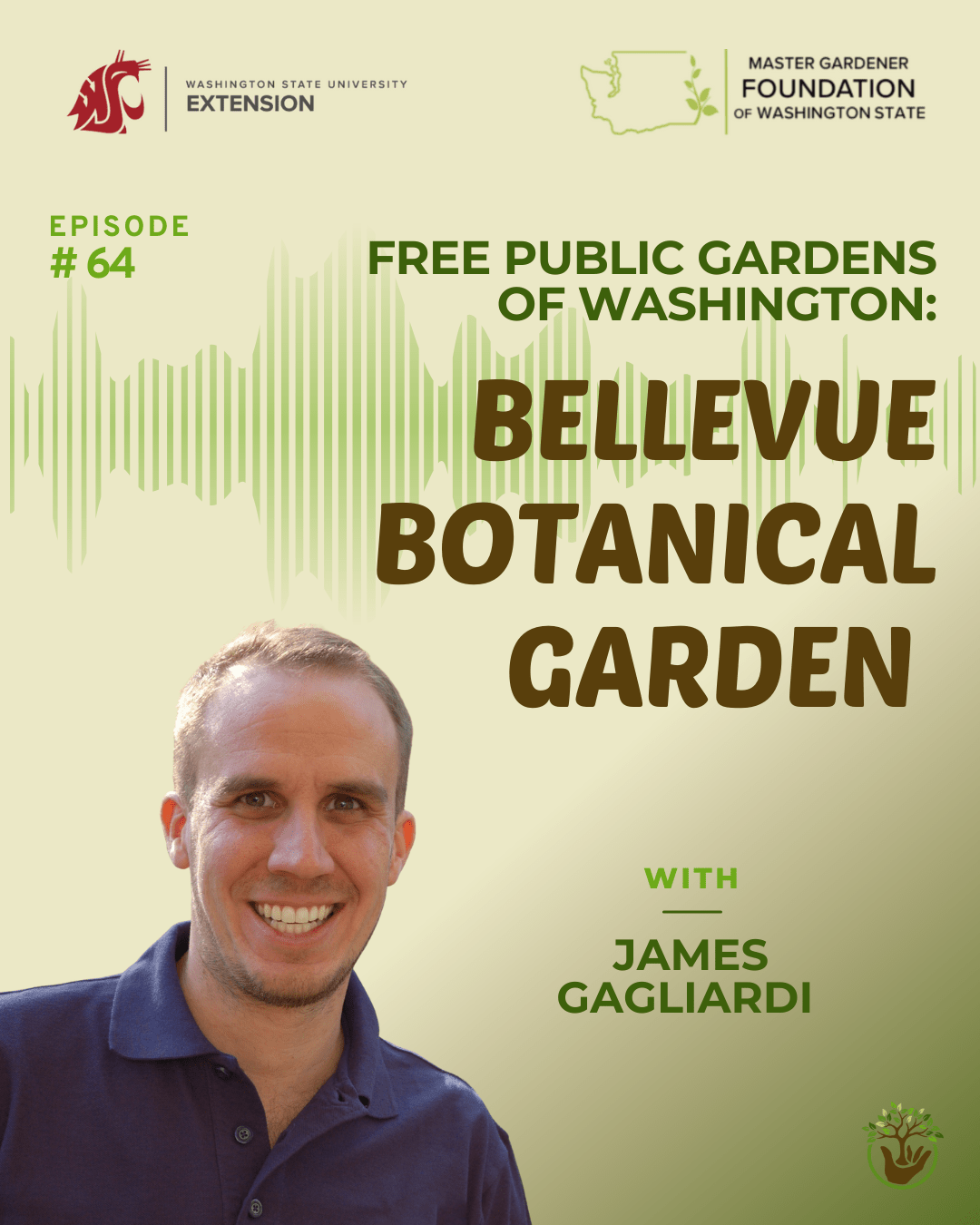
James Gagliardi shares Bellevue Botanical Garden's history, community involvement, and its role as a vital green space in an urban environment.

Affiliate Disclosure: As an Amazon Associate, the Master Gardener Foundation of Washington State earns from qualifying purchases. When you buy through our links, you’re helping The Evergreen Thumb Podcast grow—just like good fertilizer! Product recommendations are our own and do not represent the views of MGFWS or Washington State University. Thanks for supporting us!
In this episode of The Evergreen Thumb, guest James Gagliardi, the director of Bellevue Botanical Garden, shares insights into the garden’s history, community involvement, and its role as a vital green space in an urban environment. He discusses the importance of accessibility, educational opportunities for home gardeners, and the collaborative efforts in maintaining and curating the garden. The conversation also highlights future growth plans and how visitors can engage with and support the garden.
James joined the Bellevue Botanical Garden as its Director in the summer of 2022. Prior to moving West, he worked at Smithsonian Gardens in Washington, DC, and George Washington’s River Farm, headquarters of the American Horticultural Society in Alexandria, Virginia. James studied horticulture at the University of Connecticut and earned a master’s degree from the Longwood Graduate Program in Public Horticulture at the University of Delaware. James is the editor of the Smithsonian’s first gardening book, Encyclopedia of Garden Plants for Every Location.
Gardeners! We have put together a quick survey to make this show even better, and your feedback would mean a lot. It’s just a few minutes telling us about what you love, what you would change, and what you want to hear more of.
It doesn’t matter if you are brand new to the podcast or if you’ve been listening since day one, I would love to hear from you. Here’s the thing: your answers matter. The podcast team will read every single response, and they will directly shape what we do in 2026 and beyond. https://wsu.co1.qualtrics.com/jfe/form/SV_7QIbU5wb07yEGTs
Listen Now



Resources
- Bellevue Botanical Garden Society | Bellevue, WA
- Bellevue Botanical Garden on Instagram
- Habitats at Home – Bellevue Botanical Garden
- Creating Robust and Resilient Green Spaces for Nearby Nature
Transcript
[00:00] Erin Hoover:
Welcome to The Evergreen Thumb, episode 64.
My guest today is James Gagliardi, director of Bellevue Botanical Garden, in the heart of downtown Bellevue. He’s here today to tell us all about this beautiful urban public garden.
James, thanks for joining me today.
[00:18] James Gagliardi:
⁓ very happy to be here, and thank you for inviting us as a guest.
Guest Introduction
[00:22] Erin Hoover:
Tell us a little bit about yourself and the work you do for the Bellevue Botanical Garden.
[00:27] James Gagliardi:
I am James Gagliardi. I am the director of the Bellevue Botanical Garden, an employee of the city of Bellevue. I am a long-time passionate gardener, grew up in Connecticut on a 1780s colonial house. I would garden out in the back, eventually took that all over from my parents, had a little farm stand out front. Still back in the day where I can put a tin can out there, and some people would put coins in to pay for squash or cut flowers, and really grew that passion. And then eventually found the Botanic Garden world and the ability to share plants with the public was something that was so special and intriguing to me that I went on to get a master’s in Botanic Garden Management with Longwood Gardens. Outside of there I then went on to work at the American Horticulture Society, Smithsonian Gardens, and now here at Bellevue Botanical Garden
[01:25] Erin Hoover:
So what drew you to the Bellevue Botanical Garden?
[01:30] James Gagliardi:
So at the time that the job came open for the Bellevue Botanical Garden, I was looking for something a little bit different in my career. I was in Washington, DC. The pandemic had just occurred. There was an insurrection, and I decided maybe it’s time to go try somewhere else. And then just very much got interested in this idea of moving to the Pacific Northwest and working at such a great garden like Bellevue Botanical Garden.
It had a lot of advantages to it, so I was excited to make that move, try something new, and really make an impression here in the Pacific Northwest
[02:08] Erin Hoover:
So, for someone who might not be familiar with the garden, how would you describe the garden to someone visiting it for the first time?
[02:16] James Gagliardi:
I think something that we’ll hear a lot about today, through our discussio,n is community. And the Bellevue Botanical Garden is really a garden that grew from the community. It all started back in 1984 where the Shorts, Cal and Harriet Shorts, were looking to donate their home and seven-acre property to the city of Bellevue to preserve and use as park land. From there, the community within Bellevue, led by Iris and Bob Jewett, really had this idea of creating a botanical garden, something that could be over here on the east side that had that wonderful focus on plants. And that was something that the city was open to, but wanted the community to be supportive of that. So two years after that donation in 1986, the nonprofit, the Bellevue Botanical Garden Society, was formed to help manage and run the garden in tandem with the city. And then it was another six years after that that the garden opened to the public in 1992. Then we were about 30 acres. Now we’ve grown to 53 acres in total, have a beautiful visitor center, and a really robust community here. And we’re getting a visitation of about half a million people. So people still think at times we’re this quiet little garden, and we like to be that place of respite for folks, but we are busy here, we are popular, and it’s just a wonderful place to be.
[03:48] Erin Hoover:
I lived in Redmond for several years, and I didn’t even know that there was a Bellevue Botanic Garden. So I’m sure I’m not the only one. Can you kind of describe where the garden is in Bellevue?
[03:58] James Gagliardi:
Yeah, so the Bellevue Botanical Garden, we’re set up on a hill that we overlook the continuously growing skyline of Bellevue just across the main city area from 405. The property itself, 53 acres, has forest land, it has natural lands to it, and also about 15 acres of formal gardens. A 1950s Paul Kirk Mid-Century Modern Design House that’s currently our cafe, and then also a beautiful visitor center gift shop. And most importantly, when we added the visitor center about a decade ago, restrooms available for the public. And it’s important to understand too, we are a city of Bellevue Park, and we’re free and open to the public every day, 365 days a year, dawn till dusk. So great a community resource.
Everybody should come give us a visit.
Exploring the Bellevue Botanical Garden’s Features
[04:57] Erin Hoover:
The accessible green space in an urban environment. One of the Master Gardener program priorities is nearby nature. And so we’ve been following a lot of the science about how critical outdoor spaces are to physical and mental health. Do you see the effects within the city and how the garden helps people, whether it’s just to get away from the city or things like that?
[05:20] James Gagliardi:
I think that’s one of the easiest things to see that that is definitely occurring here. Bellevue is a growing city. So we’re 150,000 folks now living here, 250,000 during the day that we’re able to be here as this green resource and Bellevue parks as a whole, we’re placing ourselves as a city within a park. We strive to have this green and accessible area within a certain distance of any neighborhood, any home in the area. But Bellevue Botanical Garden really is, well, as the director, I can say it’s the jewel of Bellevue, it’s the jewel of the park system. You can check with my boss, too; she may validate that as well. But, to recognize the need for that, especially in a large tech hub like this, multicultural, it’s somewhere that’s welcoming to everybody. They can come enjoy the space. But also, there’s the other side of it that we are the number one tourist site in Bellevue. So if you go on TripAdvisor, you look at Bellevue as a city, it’s the Botanic Garden first, the mall is second, and then a whole bunch of other natural tourist sites out there as well too.
[06:33] Erin Hoover:
Can you highlight some of the areas within the garden and how maybe they’re inspirational or educational to the public, especially for home gardeners?
[06:43] James Gagliardi:
So the neat thing about Bellevue Botanical Garden is that our mission here is really to be the best, and I know best is a little bit lofty, and we may have not reached that yet, example of gardening in the Pacific Northwest for the home gardener. So when some folks visit the site here, they say, you know, it’s so quiet, it’s so peaceful, there’s not a lot of people. And once again, I said, we got half a million people, so there’s quite a bit out here.
But we’re really set up on this residential scale where there’s 12 thematic spaces that run through the garden. And everything when you’re venturing through is like going through different rooms, having different experiences with what is going on. And so that gives the advantage of somebody that’s coming to visit. You know, at 53 acres, it’s a lot of space, but it’s not grandiose in the sense that you can look at any ten square feet and say that would work well in my town home and figure out how to replicate it. So you can see all these different gardening styles, different types of plants, and different influences, and take that character, take those plants back home with you in a very practical way.
Stewardship and Volunteerism
[07:58] Erin Hoover:
So, a garden like this doesn’t take care of itself. So I know you have the society, and you have the city support. How is the garden stewarded and how is it cared for?
[08:13] James Gagliardi:
That’s always one of the biggest questions: “How does it work?” I mean, all the gardeners listening know that gardens don’t just happen magically. There’s a lot of people behind the efforts that are made to make this such a beautiful space. And I remember when I was moving across, I was leaving the Smithsonian Institution in DC, where I had a much larger staff at that time, and was showing pictures of this garden, and people were like that is so beautiful. What a wonderful space. And what’s your staff? And I gave the numbers, and they’re like, and it looks at how does that work? So, and how it works is, of course, through a dedicated staff.
On the grounds here, we have a full-time supervisor, two full-time gardeners, three part-time gardeners, a part-time curator that are all working on the garden here. But what we mainly depend on is our volunteers and our partners. Last year, we had over 325 people volunteer their time to the garden regularly. And that was a contribution of over 18,000 hours, a really substantial impact that something like that has here. And the other interesting thing to realize is this garden is really set up on a partnership model. I talked about the Bellevue Botanical Garden Society that formed before opening. They are our primary partner. They have nothing outside of this garden that they’re focused on. Their sole mission is the support of this garden. We split our staff about 50-50 at this garden. I have the gardening staff, the volunteer coordinator, the rental side of it. They’re more on the programmatic side. So they’re running the educational programs, our large events, communications, membership, fundraising. So it’s this wonderful collaboration between the two of us.
But beyond them, as our primary partner, we have nine other partners, so 10 in total. And those are nonprofits that are in the field of gardening. So folks like the Hardy Fern Foundation, the Northwest Perennial Alliance. Then we got the Fuchsia folks, the Dahlia folks, the native plant folks, Rock Garden. And of course, we’ll talk about the master gardeners a little bit further on in this discussion as well, too. All of those organizations have display gardens out here. They’re contributing time to both taking care of those gardens but also supporting our programs and other efforts.
Educational Opportunities at Bellevue Botanical Garden
[10:54] Erin Hoover:
My guess is that shared stewardship is also connecting closely to how people learn within the garden. So can we talk about how, as people are moving through the garden, what they might see, or what kind of demonstration gardens, what opportunities for learning there are there?
[11:13] James Gagliardi:
The great thing about this partnership model is certainly we have our mission as we discussed, and that all these organizations also have their mission, and we’re able to be a venue for them at the Bellevue Botanical Garden to spread their education. So you look at something like the Fuchsia Society is able to display so many different types of Fuchsia on site here, the same with the Hardy Fern Foundation, that you have this collection that people are able to get into, see different plants in situ, see the variety of plants that are available too. And then there’s some other groups, like NPA, that it’s more of that design element, putting plants together, how to display and care for them properly. And we also have an internal partner with Bellevue Utilities that runs a waterwise garden here.
All these different lessons that we’re able to take advantage of this site, take advantage of our audience, and each teach these messages that are important to the home gardener, whether this is physically done in the garden, done through tours, done through programs that are run on site, or even popularly through many of the plant sales that we host out here too.
[12:31] Erin Hoover:
I understand Master Gardeners have been doing plant clinics on-site too, occasionally.
[12:37] James Gagliardi:
Yes, so the master gardeners are a strong partner of ours. And they first came on doing plant clinics, as any master gardener is going to know, that’s deeply part of what you do, part of what you need to do to get your hours in. So it was a fitting place for us to host those clinics. And then, like other partners, I think there was this view of, we can do more. We want to touch plants. We want to get that physical and that display side on.
So when we added four containers to the front of our property here, we invited the master gardeners in to take care of those, to do the planting within it. And man, do they take care of them. They’re out here regularly doing the maintenance on it, doing the plant change out. And one of the things I noticed is there are a lot of plants jammed into those containers.
They look beautiful, but it was an organization that I looked towards, and I said, obviously they want to do more. And we had this wonderful opportunity of doing a changing display bed at our entrance. And we want to change it out every three years with a different message. It’s 800 square feet. And the first group that I thought about going to was the master gardeners. Cause I was like, that is a group that needs more space around here to show their message and engage with their volunteers.
[14:00] Erin Hoover:
That’s great.
So oftentimes, the learning turns into action at home. What opportunities are there for them to take that learning back and implement it in their own gardens?
[15:31] James Gagliardi:
Yeah, that is exactly the point is to come here. You can just come and enjoy, but if I can get you to learn, we’re really going to do something well here. And that’s what our goal is. So if we look at an example, which is the display bed that the master gardeners created with us this year, it’s a temporary three-year display. It’s called Habitats at Home. So when we struck out to create this exhibit,
We were looking for one, a message that wasn’t touched on elsewhere in the garden here. And then two, a message that fit with the master gardeners, your new pillars. And we looked at those pillars, had grand ideas if we can touch everything, and then weaned it down into a message of doing habitats at home, which is really creating a garden space that is both beautiful for us, but also enriching for wildlife and insects and pollinators.
So the question was, how do we then communicate that message? And that’s through interpretation. I come out of the museum side as well too. I’m a plant geek with a museum study certificate. So a proper garden to me is gonna be thematic. It’s going to have a plant collection in it that’s properly curated, and it’s going to have an interpretive message. So we worked with the master gardeners. We created a script.
We recreated that script. We did a lot of editing. There was a lot of back and forth. There was a lot of great participants with that. And so when you approach a garden like that, you’re going to find the welcoming message coming in, talking about the purpose. And then the clever thing we did in this garden was we installed chalkboard signs because the garden is so dynamic, both seasonally and what’s just happening with the wildlife and different things moving through that.
We wanted it to be dynamic in messaging. So we’re able to write different things on marker board signs and even created this flip field book journal that we can change out through the seasons to create the message and go along. So this is a good example of what we’re striving for in all our gardens, of being a fully curated, interpreted space.
Curating Plant Collections
[17:48] Erin Hoover:
That’s the second time you mentioned curated as you were describing this garden. So, can you tell a little more about the process of curating plants for these gardens?
[17:57] James Gagliardi:
So when I say curation, it’s the same as any museum curator, and a botanic garden like us is a living museum. There’s two sorts of ways that you can add, well, maybe three for living museums. It’s going to be plants, it’s going to be animals, and the zoo set or aquariums. So when we’re talking about a curated collection within a botanical garden, is that all of our plants are accessioned, that we have records on them.
When they come in, we’re logging not only the location they’re planted, where they’re coming from, of course, the Latin name that goes with them, and all the other important information. They get a number on them. They’re tracked in our system. And the cool thing about being part of the Bellevue community is there was a group of tech folks that came over in the early 2000s and said, we should have digitized records and one really dedicated person
that helped get us all into a newer sort of database called Access from Microsoft in the year 2000. And all of our records were captured in there. And what this has allowed us to do is have a digitized database of our plant records that is not only accessible to us as an internal tool, but accessible to the general public. So, everything, and we have 3000 varieties of plants in our garden.
is accessioned, it’s on a map. You can go onto our website, go onto our plant collection search, zoom into a map, see all the little bubbles. You can search for a plant, learn about it, and then find where it is in the garden to go. So we are this amazing resource as an accessioned and curated collection that the home gardener can come to. We see the students coming from Edmonds when they know that they need the more particular plants to study.
So, it’s a great place to learn about plants. And the one thing that I really want to highlight, too, is we’re getting even better because we had a wonderful donor that gave us a $2 million gift to endow a position, which is the first endowed position to go in perpetuity with the city for a full-time curator at this garden. So we’ve had a part-time curator for about eight years. And in 2026, that will be a full-time 40 hours a week.
in perpetuity, working on these plant collections and making them a valuable resource.
[20:26] Erin Hoover:
Excellent. So, is it the curator then that helps guide the plant choices for these gardens, or is that more up to the partners, or how does that work?
[20:39] James Gagliardi:
That’s another one of how does that work? People have so many opinions. There is a formal process, and certainly the curator and myself as director, are the protectors of the collection, the ones to make sure that we’re making the proper steps, but it is very much a collaborative process between these groups
Looking at the Hardy Fern Foundation, we just did a renovation to their garden, and we looked at what the list were. There was back and forth once again. It was very similar to the plant display that was so well designed for the habitats at home. What master gardeners a list was given, ideas were had, back and forth was gone, back and forth. And then ⁓ figuring out what is best for the garden, what is accessible.
And then two is the curation and the curator that’s looking at the plant collection as a whole. So when we have these 10 partners that are looking at their specific area, and maybe there was the desire to add something like a dogwood tree in, and they pick out a particular cultivar, but that’s already represented, and maybe we’re making the suggestion of looking at a newer cultivar, or a different selection to broaden our collection even more. So we have that here as part of the garden that people can come visit
[22:06] Erin Hoover:
Another how does it work question, how is the actual design of the individual garden spaces created? Is that again, a team thing? a partner thing, both?
[22:21] James Gagliardi:
Yeah, the design too, it’s very similar to the answer that was given for collections, which it’s a team collective. There is the professionalism with our staff, myself, the curator, and we’re looking at things holistically, but also very educated and talented volunteers. And then sometimes also engaging external professionals, too, because, what you need to realize, as I talk about, I’ve said holistic a few times, is this is a garden space, and we’re welcoming 500,000 people a year. So we need to make sure that we’re accessible and that we’re creating something that is of value for the public that’s visiting us.
Garden Problem Solving
[23:08] Erin Hoover:
What kind of challenges, gardener challenges, would the garden maybe help gardeners think through and work out, as far as how they could solve a problem or take something back to their garden?
[23:24] James Gagliardi:
Yeah, I mean, certainly, what problem solving, I wouldn’t be great on this podcast if I didn’t say come in and talk to the master gardeners at the clinic on weekends when they’re out here helping. Those are wonderful resources to get you great information. But what the value of the botanical garden and Bellevue Botanical Garden here is, is that we have this broad collection, as mentioned, 3000 varieties of plants.
There’s terrace gardens, there’s wetlands, there’s natural gardens, there’s Japanese style, woodland, all these different things. So a visitor can come in and see a plant that is maybe not working in their area and how it should be more properly positioned or see something that looks similar to their backyard and say, ⁓ maybe if I did this and then
certainly pull aside a gardener and talk to them or one of our roaming docents or a master gardener, come for a tour here led by our docents or one of the many classes. The society hosts many, the partners host many as well, including the master gardeners. So the great thing is that there’s a community here to not only see these plants, but also to talk about them, experience them. And I remember
because the Master Gardeners will not only host clinics here, but they host the Master Gardener training and some other sort of IPM integrated pest management classes, and stuff like that. And one of the Master Gardeners came over to me and they’re like, so you have this sickly plant. Is it okay if we take the class over there to look at it? And it’s sort of pointing out that everything’s not perfect at the Botanic Garden. It’s not our strive to be perfect that we are very much a realistic garden. So we’re very happy to share that. Well, we’re not happy to share, but we do have diseases, we do have our own issues, and we’re able to talk about that as well. But also have wonderful exhibits like Habitats at Home that show a little bit of chewing on leaves is not a bad thing. Let’s have a happy, balanced ecosystem, not a perfect garden.
Future Growth and Development of Bellevue Botanical Garden
[25:39] Erin Hoover:
Great. So looking ahead, what do you see in the future for Bellevue Botanical?
[25:48] James Gagliardi:
The future for the Botanic Garden is bright, and it’s also growing. So, since I arrived about three and a half years ago, attendance has increased 16 and a half percent. So there’s more and more people coming here. There’s more and more attention to the garden. So it’s figuring out how we work with that growing attention to make sure we’re still providing the value, still serving our mission, but also serving the visitors.
We have a growing focus here on the visitor services side, and that’s actually one of the newest positions with our nonprofit, the Bellevue Botanical Garden Society, is a visitor services manager. We’ve had guests here, I’ve met them in the garden, had a wonderful two hours walking around, but I wanna leave, and I don’t know how to leave the garden. So we’re gonna work on some more things, a little bit better wayfinding through the garden, some more of those interpretive signage, so people know what they’re looking at. But one of my bigger focuses is looking further into the future, too, is the more growth that’s coming to this area. So the city has been growing, but there are plans in our immediate area.
The Wilburton Vision, which is our neighborhood that we’re in, is a rezoning. So bringing high rises across 405 and more mixed-use in the area is certainly going to grow what we have directly here. There’s also, with the City of Bellevue, a very progressive project going on which is connecting all the way down from Meydenbauer Bay Park across the highway here, and that’s called the Grand Connection, and that’s really going to then connect us more with that downtown core.
And the other things that I’m looking at in this area are certainly East Link, which we’ve seen about four rail stations open within a mile and a quarter of us. And hopefully, fingers crossed, within months, if not sooner, we’ll have that connection into Seattle, which makes us even more accessible. And then the other thing that can bring a lot of folks to us is the East Rail, which is the train rail conversion to bike trail and walking path that’s all the way up from Woodinville down to Renton, that 40 miles. And that will be coming on more in the Bellevue piece, getting finished along with that large wooden trestle bridge next to us. So all I see is more people coming and making sure that we’re ready for them, but not losing our focus.
[28:32] Erin Hoover:
All right, wow, that’s amazing. That’s possibilities for growth. So, how can visitors find you, or how can they support the garden?
[28:44] James Gagliardi:
Certainly, go on to our website, BellevueBotanical.org, to find out any more information, whether it’s on visiting whether it’s joining us as a volunteer. But the best thing to do is come out and visit us. Like I said, we’re open 365 days a year, sunrise to sunset. There is no pay to get in. So it’s a free garden. We’re removing the barriers for participation. There’ll even be more access to public transportation coming in the future.
So come out and visit, join us for plant sales, come for the plant clinics, be engaged here. Know that this is a community resource for you to learn about plants, to enjoy nature, to just get that respite and that education, and take advantage of it.
[29:31] Erin Hoover:
Any final thoughts you wanna share about the garden?
[29:35] James Gagliardi:
I just want to share how lucky I am to be part of this garden and how Bellevue Botanical Garden as a whole is just lucky to be part of the Bellevue community, the Eastside community, the Pacific Northwest community, that there’s so much great horticulture out here and there’s so many great people that are willing to participate and help and make this the best garden it can be for the people. And not to brag because it’s never a competition, but there was a poll a few years ago from King 5 for the best botanic garden, and we did win it. So the people think we’re pretty good, and I appreciate that sentiment, and hope to see so many of your listeners and the master gardeners just become more and more engaged here.
[30:23] Erin Hoover:
Thank you so much for being here. This was wonderful.
[30:25] James Gagliardi:
Thank you.