
Vegetable Crop Rotation Secrets to Save Time and Soil
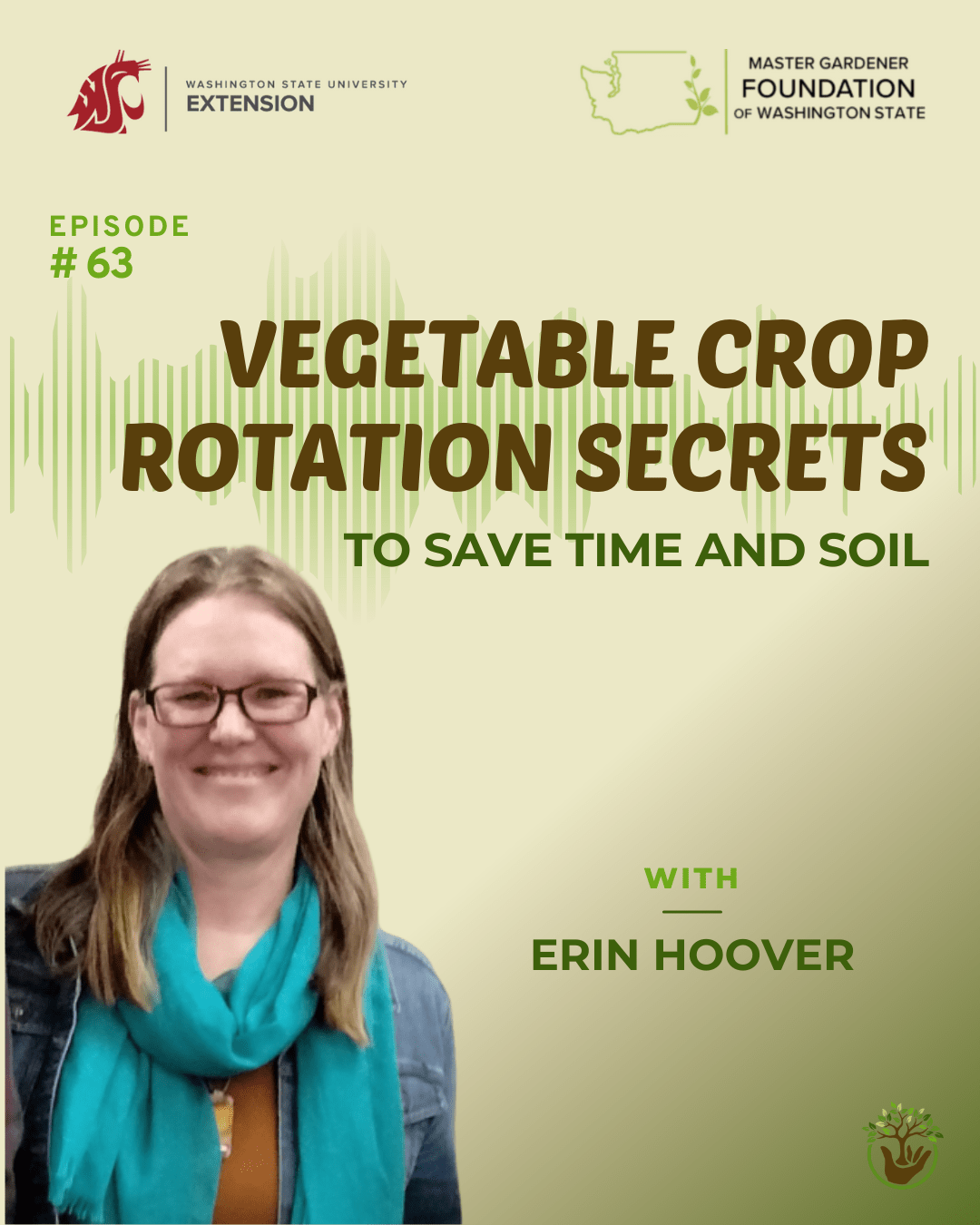
Curious about crop rotation? Host Erin Hoover discusses why crop rotation is important and shares two systems to help you get started in your vegetable garden.

Affiliate Disclosure: As an Amazon Associate, the Master Gardener Foundation of Washington State earns from qualifying purchases. When you buy through our links, you’re helping The Evergreen Thumb Podcast grow—just like good fertilizer! Product recommendations are our own and do not represent the views of MGFWS or Washington State University. Thanks for supporting us!
In this episode of The Evergreen Thumb, host Erin Hoover discusses the importance of crop rotation in vegetable gardening, explaining how it helps control pests, prevent soil-borne diseases, and maintain soil health. Erin highlights two main crop rotation systems: the “leaf, root, flower, fruit” system and Eliot Coleman’s crop rotation system. The episode offers practical advice on adapting these systems to your own garden size and needs and stresses the value of keeping records on what worked or did not work in your garden. Erin ends the episode by encouraging listeners to experiment with different methods and to see what works best in their spaces.
We’d love your feedback! 🌱
Your input helps The Evergreen Thumb improve and bring you more of the gardening content you care about. Please take a few minutes to complete our listener survey and share your thoughts.
Take the survey here: https://wsu.co1.qualtrics.com/jfe/form/SV_7QIbU5wb07yEGTs
Thank you for helping us grow!
Erin has been a WSU Extension Master Gardener since 2015. She first trained in Skagit County, then moved to Grays Harbor County in 2016, bringing her gardening skills along with her. Growing up surrounded by Washington’s lush landscapes, she’s always felt connected to nature, which eventually led her to become a certified Master Gardener and Permaculture Designer.
As a homesteader, Erin has turned her own property into a small, thriving farm. She grows veggies, tends to fruit trees and shrubs, and raises livestock, all while following permaculture principles to keep things as sustainable as possible. Her focus these days is on finding new uses for native plants, figuring out ways to feed her animals from her land, and growing her own food.
When she’s not working on the homestead or recording The Evergreen Thumb, you’ll find Erin out exploring Washington’s mountains, forests, and beaches—always looking for ideas and inspiration to bring back to her garden.
Listen Now



Resources
- The New Organic Grower
- Maritime Northwest Garden Guide
- Pacific Northwest Gardener’s Handbook (It’s FREE!)
- Two Practical Crop Rotation Methods For Vegetable Gardens
- Crop Rotation in Home Gardens (WSU Snohomish)
- Crop Rotation in the Vegetable Garden
- Using Crop Rotation in Home Vegetable Garden
- A different approach: 4-Step Crop Rotation Plan – The Garden Academy
Transcript
[00:00:10] Welcome to The Evergreen Thumb, episode 63. Today’s episode is all about crop rotation. Did you know that crop rotation is one of the most critical and yet the most under-utilized practice in vegetable gardening? We’re going to talk about why it’s important to rotate your crops, especially in the vegetable garden.
[00:00:34] And we’ll also touch on a couple of different rotation techniques.
Crop rotation is one of the least understood, but most critical practices in a vegetable garden. And there’s more than one way to rotate your crops, which is actually the good news.
What is Crop Rotation?
[00:01:00] Crop rotation is a cultural technique that helps to manage pests and disease. It helps to maintain soil health and nutrient cycling, and a lot of different gardeners have developed different systems based on their priorities the most, in part, in part is choosing a system that suits your garden, your goals, and what matters most to you.
Two Crop Rotation Systems
So today we’re going to talk about two different crop rotation systems.
[00:01:25] These just happen to be the two that I am most familiar with. There are variations on these, and it doesn’t necessarily have to be as complex or as complicated as either of these two systems.
The key factor you’re looking for is that you want to not plant the same crop in the same space over and over again, depending on the crop.
[00:01:46] There are a number of pests or pathogens that infect that plant, and they need a certain number of years to not have that plant in the soil in order to interrupt the cycle of that pest or disease.
[00:02:11] And the Pacific Northwest Gardener’s Handbook Gardening for the Future is the new WSU Extension Gardener’s Handbook and was just revised and edited in 2025, and they have an entire chart in here that talks about the crop, the most common diseases that can affect this crop, and the rotation recommendation, depending on that disease or pest cycle.
So, for instance, I’m looking at the chart right now. So this chart is about four pages long, and it’s alphabetical.
Common Soil-Borne Diseases Prevented by Crop Rotation
[00:02:45] It’s not an exhaustive list, but it’s probably the most common soil-borne diseases that you’re trying to prevent by doing a lot of these crop rotations.
So probably the one most home vegetable gardeners are familiar with are like in tomatoes, there’s early blight, there’s wilts, there are Bacterial canker, Bacterial spot, and Anthracnose are the most common ones in tomatoes.
[00:03:12] Those affect other crops as well in the same family, so like Anthracnose is also in peppers. Potatoes are also susceptible to Early blight, like tomatoes are.
So this chart gives you a recommendation if you plant a tomato for the best chance of cutting the disease cycle for Early blight, you want to wait three to four years before you plant another crop that is susceptible to Early blight, whether that’s tomato again or potatoes.
[00:03:47] Potatoes are susceptible to Verticillium wilt, and this chart has a rotation recommendation of three to four years, which tends to be about average, I would say, for most disease cycles.
But it specifically says, do not plant Solanaceous, which is the potato family, Cucurbits, which are squash, mint, or nursery maple crops, and rotate with alfalfa or cereals. So that is going to be your best chance to interrupt the disease lifecycle of Verticillium wilt on potatoes.
Leaf, Root, Flower, Fruit
[00:04:15] This is more of an explanation of why we rotate crops, but also a resource to give you actual numbers if you don’t wanna take up one of these two methods that I’m gonna talk about today.
So the crop rotation technique that I tend to use the most is known as leaf, root, flower, fruit.
[00:04:50] And there are variations on this as to what the, what each is classified as, but I learned about this technique from theMaritime Northwest Garden Guide, which is, uh, published by Seattle Tilth. And, uh, if you don’t have this book, this is a great book.
It goes month by month to covers what to do in the garden, and then it has an article or two about different gardening techniques like crop rotation, seed starting.
[00:05:18] In June, there’s an article on getting to know beneficial insects. In October, there’s a chart for annual winter cover crops. There’s an article about nitrogen fixing. All kinds of things. So that’s just an example of some of the things that are in this book. But these are all going to be more specifically tailored to the Maritime Northwest.
[00:05:37] So it’s going to be west of the Cascades, Washington, and into Oregon. But a lot of the tips and the articles that they provide are valid beyond the Maritime Northwest.
This crop rotation technique, it recommends starting off with a leaf crop that’s well-manured and were well-fertilized because leaf crops require a lot of nitrogen.
[00:06:03] So that’s your leaf of the leaf, root, flower, fruit. So when you harvest that, that leaf crop, in this case, I say lettuce, you want to plant a root crop. Root crops require less nitrogen but need more potassium and trace minerals. So, because of this, you shouldn’t need a fertilizer input for the second crop, though you could add some compost to the soil.
[00:06:30] So the next point in the rotation is the flowers. For me, that might mean flowers as pollinator attractors. So that’s kind of an obvious choice, but they also provide, like I said, beneficial insects. They just are pretty; they’re a pretty addition to the garden. You could also use, uh, flowers as cover crops.
[00:06:50] So some flowers like Buckwheat, Phacelia, or even Marigolds can be used as a cover crop. And then you turn them in before they go to seed, almost any cover cro,p like a legume cover crop, like a, a vetch or uh, a winter pea or something like that, can also be used in the flower example because it’s putting nutrients back into the soil.
[00:07:15] So a cover crop is going to be a green manure, or it’s going to be a nitrogen fixer.
And then your fruits are going to be your crops, like tomatoes, peppers, and corn. Well, technically, not a fruit fits into this category, and they’ll all grow well in that soil with all that organic matter from the cover crop.
If you do it right, you can succession plant this, so there’s something in your garden bed all times of the year, which helps keep that soil in its place because you have live roots in the ground.
A Leaf, Root, Flower, Fruit Crop Rotation Example
[00:07:53] They have illustrations in this book that walk through how a progression might look. Uh, so I’ll just kind of go over that real briefly.
For year one, if you grow a leafy plant, that could be, uh, lettuce. This is in the fall. You could put in winter greens like chard, fall broccoli, or cauliflower, or fall lettuce.
[00:08:15] And then in the winter, you’re going to side dress ‘em with a little bit of compost to give them a little winter boost. Depending on where you’re at, you might mulch ‘em a little bit. And then in the spring, you’re going to sow a root crop like carrots and parsnips. And then in the summer, you’re going to thin those out. If mulch isn’t on there, you want to add a little mulch to protect them.
[00:08:36] And then in the fall (this will be the fall of the second year) So, ‘cause we’ve gone through all four seasons, you will harvest those carrots, and again, in the winter, you’ll continue to harvest the carrots.
And then in the spring of year two, you can sow Phacelia as a cover crop that you would then turn under in the fall once it starts flowering. Because Phacelia, you don’t want it to go to seed because it self-sows very readily.
[00:09:07] And then in the summer you will sow beans, and that will fix nitrogen.
So that’s just one example of how that leaf root flower fruit works. It’s organized by what the plant produces, which is an indicator of its nutrient needs.
[00:09:31] It works great for beginners, for people who are focused on soil fertility, and it’s a simple system that’s pretty easy to utilize. And remember, there are some variations in here that may not seem intuitive. Like in this example, they treat leeks as a leaf crop because the aerial green parts the same with garlic. It’s also considered a leaf crop because of the aerial green parts.
[00:09:54] Even though we eat the root and onions as well, all of the alliums are treated as leaf crops.
And then the other trick to this, like I said, if you’re doing leaf, root, flower, fruit, you still also have to take into account the nightshade family plants, because potatoes and tomatoes are either a root crop or a fruit crop, but they are both nightshades, so they both have some of the same diseases.
[00:10:20] So you need to make sure that, um, you’re taking that into account as well, and you want to make sure, because those are only going to be two years apart from that rotation. You want to adjust that rotation, um, so that there’s at least three, if not four years, uh, between those two crops.
Listener Survey
[00:10:51] Hey, gardeners, I want to take a quick break from this episode because I would love your help with something. I’m putting together a quick survey to make this show even better, and your feedback would mean a lot to me. It’s just a few minutes telling us about what you love, what you would change, and what you want to hear more of.
[00:11:09] It doesn’t matter if you are brand new to the podcast or if you’ve been listening since day one, I would love to hear from you. You can find links to the survey on our social media in the show notes or the episode description for this episode. But here’s the thing, your answers matter. I will read every single response, and they will directly shape what we do in 2026 and beyond.
[00:11:38] So if you’ve got a few minutes after this episode, I’d really appreciate it. You can also find a link on our website theevergreenthumb.org, and there will be a link on the homepage at the top in the header that says survey. Again, that’s theevergreenthumb.org, and the link will say survey. Thanks so much. Now let’s get back to the episode.
Eliot Coleman’s Crop Rotation System
[00:12:03] So the second system that I’m going to talk about, from Eliot Coleman from his book, The New Organic Grower, this was originally written for larger systems and market gardeners, but it can be easily adapted to small-scale home gardens. He has an entire chapter on crop rotation and how to know when you’re rotating your crops, how much space each of those crops need.
[00:12:36] Because something like corn is going to take up a lot more space in the garden than, say, radishes.
So, he goes really in depth into why crop rotation is important for, like I said, disease control, soil nutrient balancing. But he even goes into how it affects yields and some patterns that he has determined from his own experience and from studies he’s read on good and bad rotational effects.
[00:13:02] Things like potatoes yield best after corn, and certain crops are beneficial as a preceding crop, like lettuces and squashes, are considered a preceding crop, and legumes are also a preceding crop, so they go better in front of certain crops. In his experience, carrots, beets and cabbages are generally detrimental to subsequent crops.
[00:13:24] It’s definitely a more complex system, but he does say that these are merely patterns, not absolutes. The factor in your crop rotation for this is basically how many plots do you have? How many beds do you have if you get raised beds? Now, if you only have two and you wanna grow corn and beans, well corn goes to one and beans to the other, and then you swap ‘em.
[00:13:51] Um, that’s, you don’t really have much choice, but as you continue to add beds, it can get more complicated, and because there’s so many more possibilities. And he also says, having two dozen crops does not necessarily mean you’re on a 24-year rotation. Each section can be divided, so each bed can be divided into two or three separate and shorter rotational cropping plans.
[00:14:13] So if you have a larger garden, you can make all these decisions to suit your situation. He actually recommends using three-by-five cards with the crop name on them and the number of beds so that you can actually play with this and visualize it in your garden. Um, and if you don’t have this book and you do a lot of extensive vegetable gardening, I would highly recommend it.
Sample Eight-Year Rotation
[00:14:35] He does offer some very specific examples because, as he says, the reality is not often as perfect as the ideal, but he does have a, a sample eight-year rotation. And this particular rotation does not include greens because he grows greens in a separate kitchen garden. But this rotation is potatoes, corn, cabbage family, or brassicas, peas, tomatoes, beans, root crops, and squash.
[00:15:09] And potatoes follow sweet corn because research has shown corn to be one of the preceding crops that most benefit the yield of potatoes. And then corn is grown after the cabbage family because corn shows no yield decline when following a crop of brassica. And that cabbage family can be sewn to a green manure that provides more nitrogen for that corn the following year.
[00:15:36] Cabbage follows peas because the peas finish early, so you can allow a vigorous green manure crop, or you can grow fall brassicas. And then peas follow tomatoes because they need an early seedbed, and the tomatoes can be under-sown with a non-winter-hardy green manure that provides soil protection over the winter.
[00:16:00] And then tomatoes follow beans because this places them four years away from the potato. And then beans follow root crops because they’re not known to be subject to the detrimental effect that of certain root crops, such as carrots and beets, may exert the following year. And the root crops follow squash because they’re considered a cleaning crop.
[00:16:22] They’re easy to keep weed-free, and there are fewer weeds to contend with within the root crops, which is important because the root crops are the most difficult to keep cleanly cultivated to get in there and get all those weeds out. And then squash is grown after potatoes in order to have two cleaning crops back to back prior to the root crops, thus reducing weed problems in the root crops.
[00:16:51] So I know that might not have been real easy to follow, and I can provide kind of a little outline of how that works for reference. But again, I highly recommend this book. This is better for more experienced gardeners. It’s a more complex system, or if you are growing on a larger scale, like I mentioned there, because there’s green manures and succession planting possibilities for soil building, it helps prevent family-specific pests and diseases like the leaf, root, flower, fruit by spacing in time.
[00:17:26] So the differences between the two, again, like I said, the leaf, root, flower, fruit is a bit more straightforward. It’s easier to follow if you’re a newer gardener, whereas the Eliot Coleman method is kind of for more advanced gardeners or for more, um, production gardeners, but really there’s, there’s no one way to rotate crops.
[00:17:46] And I’d encourage you to do some research, and there are other methods out there, but I would recommend downloading The Pacific Northwest Gardener’s Handbook because that will tell you all the key vegetable crops. There is that chart that gives you exactly how many years you need between replanting the same crop or planting another crop in the same family.
Record Keeping for Vegetable Crop Rotation
[00:18:07] Another big difference is the learning curve and the record-keeping. Once I had my rotation set up, so I have enough garden beds that I actually have, one section is done on one rotation, and the other section is done on another rotation. So, I can kind of trial ‘em side by side and see what works best.
[00:18:24] And so what I did is I took a free 3D planning software, and I planned out the rotation for one year. So, like I say, year one, and then I save it again for year two, but then I rotate. I like slide all the label names for each garden bed to the next bed. So, then I have year two, and it’s a six-year rotation because I have six beds.
[00:18:46] So that’s how I manage and keep track of my rotation as far as the record keeping, a lot of it is just coming down to whether you keep a garden journal or what I do is, um, I just write a little note I have a Trello board that has all the things I do in my garden month to month, and at the end I have a yearly summary that I just say, okay, 2025, here’s what worked, here’s what didn’t. Here’s what I want to do differently.
[00:19:14] Um, and if I see that for some reason a rotation didn’t work well because I got a disease or because something didn’t thrive that year, I make a note of that to see if I can see a pattern from one year to the next. So, it is important to keep records to see how successful these rotations work for you.
[00:19:34] Just keep in mind that this does not eliminate the need for soil amendments. Cover crops and green manure will help return nutrients to the soil, and you’re helping to balance what nutrients are being used by not putting like a heavy nitrogen feeder back-to-back. But you still need to add compost, manure, or green material to decompose in the beds to add those nutrients back into the soil.
How to Make Crop Rotation Work in Your Garden
[00:20:11] You may be asking, how do I make this work in my garden? Ask yourself, what are your biggest challenges? Are they pests, disease, soil depletion? And then decide based on your experience and your garden goals and your biggest challenges, how do you want to do this rotation? What version or adapting uh, a mixture of both, or one with something that I didn’t talk about today, another method.
[00:20:36] How can you adapt those to best suit your garden? Well, if you only have four rows or four garden beds for vegetables, you may have to alternate between growing tomatoes and potatoes. Or maybe you don’t like potatoes, you just like to grow tomatoes, and then you don’t have to worry about that particular crop’s, uh, disease cycle.
[00:20:54] But I would say start simple. Use that chart with your props that you have had disease issues with in the past, or if you are particularly worried about a, a disease, and make sure that you are spacing them and not planting that crop in that same space too soon.
A Final Thought on the Two Systems
[00:21:22] So some of the things I hope you got out of this episode: Successful rotation is about understanding the principles behind it. Both systems are different. Neither one is right, but they have different benefits, different levels of complexity that need to be taken into account. So keep that in mind as you start to think about crop rotation.
[00:21:46] Both approaches are based in the same foundation of soil health and plant relationships and how to maintain soil health as much as possible and mitigate disease and pest issues, I would just encourage you to pick one, try it, and then adjust based on your observations.
I will include, as I said, I’ll include kind of a summary of Eliot Coleman’s crop rotation philosophy and one of the leaf, root, flower, fruit.
[00:22:17] I will also include links to both of those books, The New Organic Grower and the Seattle Tilth’s Maritime Northwest Garden Guide, so that you can check those out if you wish. I’ll also include a link to The Pacific Northwest Gardener’s Handbook, so you can, there’s a whole chapter in there about vegetable gardening and they talk a lot about the disease and the crop rotations and all these things.
[00:22:42] There are going to be plenty of resources, so don’t miss out on those on our website at theevergreenthumb.org. You can just search for episode 63, or if you follow us on social media, we’ll be posting links to all those. So I hope you learned a nice bit about crop rotation and the importance of rotating and spacing crops in your vegetable garden.
[00:23:07] I’d love to hear what your favorite crop rotation method is, if that’s something that you already do. And if you are learning about crop rotation for the first time, let me know what you plan to try. I’d love to hear from you.
Thanks for listening. Happy gardening.
Thank you for joining us on this episode of The Evergreen Thumb, brought to you by the WSU Extension Master Gardener Program volunteers, and sponsored by the Master Gardener Foundation of Washington State.
[00:23:32] We hope that today’s discussion has inspired and equipped you with valuable insights to nurture your garden. The Master Gardener Foundation of Washington State is a nonprofit organization whose primary purpose is to provide unifying support and advocacy for WSU Extension Master Gardener programs throughout Washington State.
[00:23:51] To support the Master Gardener Foundation of Washington State, visit www.mastergardenerfoundation.org/donate.
Whether you’re an experienced Master Gardener or just starting out, the WSU Extension Master Gardener Program is here to support you every step of the way. WSU Extension Master Gardeners empower and sustain diverse communities with relevant, unbiased, research-based horticulture education.
[00:24:16] Reach out to your local WSU extension office to connect with Master Gardeners and tap into a wealth of resources that can help you achieve gardening success. To learn more about the program or how to become a Master Gardener. Visit mastergardener.wsu.edu/get-involved.
If you enjoyed today’s episode and want to stay connected with us, be sure to subscribe to future episodes filled with expert tips, fascinating stories, and practical advice.
[00:24:43] Don’t forget to leave a review and share it with fellow gardeners to spread the joy of gardening. Questions or comments to be addressed in future episodes can be sent to hello@theevergreenthumb.org.
The views, thoughts, and opinions expressed by guests of this podcast are their own and do not imply endorsement by Washington State University or the Master Gardener Foundation of Washington State